



A CFO’s Guide to Building a Future-Proof IT Strategy in Eras of Economic Volatility & Tech Evolution
IT is no longer a cost center; it’s a crucial driver of growth and a defense mechanism against risk.
As technology rapidly evolves, your role as a fractional CFO is becoming more and more intertwined with critical IT functions. It’s essential to help your clients make the right investments that build competitive advantage while defending against threats.
Economic volatility also comes into play here, as uncertain market conditions can affect your clients’ decision making and strategic focus.
That’s why your clients need a strong leader to help them navigate these difficulties—someone who can champion forward-thinking IT strategies and demonstrate measurable ROI.
In this digital transformation strategy guide for CFOs, you’ll discover how to collaborate with your clients to build a future-proof IT strategy designed to withstand market changes and economic downturns.
You’ll also gain access to a CFO Technology Scorecard to help assess the strategic impact of every IT investment. This asset can help you advise your clients and ensure they prioritize the right initiatives.
In this Guide:
- Core pillars of a future-oriented IT strategy
- Tips for building an agile IT budget
- Technology trends in 2026
- The financial cost of not modernizing IT systems
- CFO Technology Scorecard to assess the strategic value of every major IT initiative
- Checklist for creating a future-proof IT strategy
The Modern IT Strategy: What It Really Means in 2026
In 2026, creating an IT strategy is no longer only about providing break/fix support and simply maintaining existing business systems. Instead, it transcends basic planning to focus on creating a digital transformation strategy that reaches across an entire enterprise.
IT is now a core aspect of business performance, risk management, and market leadership.
As a fractional CFO, strategic planning should include this shift in focus, as risk management has become a major aspect of your role. Later on, we’ll share a scorecard that you can use immediately to assist with the planning process.
The CFO’s Evolving Responsibilities
Finance leaders are no longer passively approving IT budget optimization requests; instead, they’re playing a larger role in strategic IT planning.
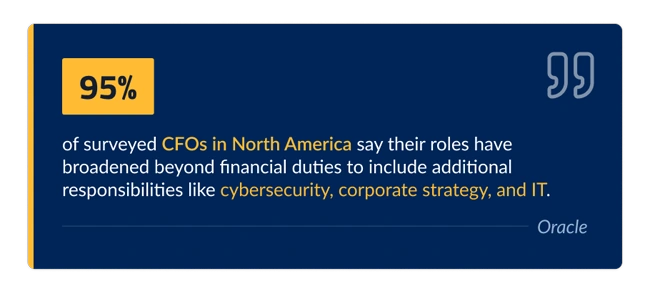
Consider this: 95% of surveyed CFOs in North America say that their roles have significantly broadened to include additional responsibilities beyond financial duties.
These expectations can include building a technology roadmap, ensuring alignment with regulatory requirements, prioritizing risk mitigation strategies, and more.
Today’s fractional CFO needs to be sure all IT costs support strategic business objectives and provide a strong ROI.
Your IT responsibilities may mean analyzing technology assessment results, researching cybersecurity initiatives, and collaborating with external experts to build a technology roadmap.
Bridging CFO/CIO Collaboration Gaps
In addition to extra job responsibilities, your fractional CFO role has also expanded to include closer partnerships with your clients’ CIOs. Though you aren’t directly responsible for implementing cybersecurity programs, you should work closely with the CIO on strategic IT planning measures.
It’s essential to make sure your clients are adequately managing risk. Proper IT risk management is a vital part of both your role and the CIO’s role.
This deeper level of collaboration, with help from a shared IT strategy framework, turns IT from a separate expense into planned risk management with measurable ROI.
The Impact of Economic Cycles on IT Spending
Economic cycles can have major impacts on IT spending and resource allocation, as they cause businesses to reduce or increase technology budgets accordingly.
As a result, modern IT strategies must be adaptable and responsive to market changes.
During volatile economic periods, it’s essential to partner with your clients’ CIO to ensure the most critical risks and projects are still being addressed.
For instance, make sure your clients understand the essential nature of cybersecurity investments.
If businesses choose to eliminate security frameworks during a period of economic decline, it can actually cost more in the long run if they end up being the victim of a cyberattack.
That’s because incident response, containment, and recovery, not to mention post-breach legal fees, regulatory penalties, and reputational damage, are more expensive than implementing a strong cybersecurity strategy and proactive controls.
Periods of economic volatility aren’t the only times to review your clients’ IT roadmaps.
Times of growth require changes, too; your clients’ IT strategies must be able to scale up and support increased sales, staff, and systems if necessary.
A consistent IT strategy framework can help guide these changes and ensure they remain aligned with larger goals.
Why Economic Volatility Demands a Future-Proof IT Strategy
Economic turbulence indicates large changes in markets; these swings can include unstable economic conditions and pricing shifts.
As a result, a resilient, future-proof IT strategy is necessary to counteract potential changes and help your clients maintain their growth trajectory.
Consider the key risks of economic volatility and how it negatively affects companies without a flexible IT strategy in place.
1. Inflation & Rising Costs
Inflation can directly translate into rising labor and technology costs for your clients. The prices of hardware and software, as well as the costs to hire IT specialists, can climb unexpectedly.
These additional costs put a strain on already tight operating budgets.
A future-proof, strategic IT plan anticipates these changes by prioritizing items like flexible cloud services and automation to increase productivity while reducing expenses.
2. Supply Chain Disruption
Global supply chain issues can have major impacts on IT purchasing and project timelines, affecting your clients’ overall technology strategy.
For instance, delays in shipping and receiving equipment can lead to operational and strategic setbacks.
To build a forward-thinking strategy, your clients can prioritize software-centric projects and updates.
They can also revisit their investment frameworks to allocate resources toward the right projects if they face major logistical delays or resource constraints.
3. Increased Cyber Expenses
Cyberattacks can be incredibly costly; some businesses shutter their doors for good after experiencing a devastating security incident.
The long-term financial fallout from a data breach can include regulatory penalties, legal costs, and loss of future revenue. IBM research shows that the average cost of a data breach, worldwide, was $4.4M in 2025.
Often, businesses find that the costs of recovering from an incident can vastly outweigh the expense of implementing proactive security measures. Taking the right protective steps can also reduce the likelihood of an attack occurring in the first place.
4. Unpredictable Budgets
Market volatility can lead to budget uncertainty, making it difficult to effectively plan and implement an IT strategy. Fractional CFOs should prioritize building an IT budget that can be easily scaled up or down without losing critical security measures.
Rigid budgets may lead businesses to give up long-term strategic projects for short-term savings. This approach can lead to the acquisition of technical debt, which ultimately creates more costs and complexity down the road.
Moving towards agile budgeting can help organizations adjust spending in real time while protecting critical security investments and core systems.
5. Adaptation Failures
Failing to adapt to new technology benchmarks creates significant risk, as outdated IT infrastructure can be extremely costly and risky.
For instance, old IT infrastructure can lead to reduced employee productivity, leading to a large annual loss when multiplied across all of your clients’ employees.
In addition, outdated systems are often more vulnerable to cyberattacks. Some of these platforms are no longer supported or patched anymore and may not be compatible with the newest security technologies.
A future-proof IT strategy is built on the understanding that modernizing infrastructure guards against cyber risks while boosting efficiency.
Example Pillars of a Future-Proof IT Strategy

Building a resilient IT strategy that can survive economic turbulence and technological shifts requires focus.
The following pillar examples reflect items that move IT spend away from a reactive-only strategy to a proactive technology investment that allows for growth, efficiency, and risk mitigation.
1. Business Alignment & Value Mapping
Creating quantifiable business value is the first step in building a future-oriented IT strategy.
You’ll want to connect IT initiatives to revenue, cost reduction, and risk mitigation outcomes.
Formulas like the Expected Loss Formula (Expected Loss = Probability × Impact) and ROI calculations (ROI = Reduction in Expected Loss – Investment Cost) can help you quantify the worth of specific technical investments.
Using data-driven methods and an objective approach is crucial here, as these will help you understand which projects to start with.
A comprehensive scorecard can be used to help evaluate the ROI of various tech initiatives to ensure that your clients invest in high-impact, high-return projects.
We’ll share a sample scorecard later that you can use to guide your efforts.
2. Security-First Architecture
Cyberattacks represent a major financial risk to your clients.
The cost of a data breach often outweighs the costs of proactive cybersecurity measures.
Data breach costs include more than recovery expenses and legal penalties; they can also result in reputational damage and loss of future business.
Modern cyber defenses use advanced measures like AI-powered threat detection and zero trust models to reduce risk and build strong levels of protection.
3. Cloud Readiness & Modern Infrastructure
Modernizing essential IT infrastructure by utilizing cloud technology and optimizing current cloud costs is a crucial aspect of any future-oriented IT strategy.
For instance, cloud cost optimization is one way to reduce overcharges and ensure your clients are only paying for what they need.
IBM found that organizations waste 32% of their total spend on cloud services, making it crucial to uncover specific unused areas and eliminate those costs.
Creating an exclusive FinOps team can also lead to greater oversight and ensure continuous governance over cloud costs. This team can include experts from finance, technology, and other departments to provide greater visibility into current costs and unused resources.
In addition, cloud services can be scaled more easily than other technology avenues; your clients can use automation to scale resources up or down, meaning less work for their teams and greater cost savings.
Overall, it’s best to align cloud costs with broader organizational goals. Make sure you take a proactive approach to managing costs to ensure that budgets aren’t being wasted on unused services.
4. Workforce & Process Automation
Automation can directly lead to increased productivity, improved operational efficiency, and cost savings for your clients.
Although these savings vary depending on the business and specific applications, companies report saving between $10,000 and several million annually by implementing these solutions.
More and more businesses are taking advantage of automation. 2024 research shows that 66% of companies had reportedly automated at least one process at their business.
Strategically implementing automation solutions is often the best approach. Typically, your clients should automate tasks that free up time so employees can focus on higher-value efforts.
This shift boosts productivity and saves operating costs, allowing your clients to accomplish more with less resources.
5. Data Governance & Analytics Maturity
High-quality data is crucial to help your clients’ leaders make informed decisions and drive the success of their overall IT strategy.
According to Gartner’s 2020 research, poor data quality costs the average business $12.9 million annually.
These issues can stem from inconsistent and unstandardized data, increasingly strict regulatory requirements, a lack of skilled resources, and a lack of accountability.
To combat this issue, a centralized data architecture can break down communication silos while ensuring quality and access. Plus, integrated solutions with real-time analytics can enable stronger forecasting accuracy.
Having instantaneous access like this can help your clients move from guesses to forward-thinking financial modeling.
It also enables confident executive-level reporting, providing the best insights needed to make critical decisions.
With a strong data strategy in place, you can help your clients make the most strategic IT planning decisions during economic downturns or periods of market volatility.
CFO Playbook: Building an Agile, Evolving IT Budget

During periods of economic uncertainty, your role may shift from cost controlling to strategic financial management.
A playbook can help you build a future-proof IT strategy and budget that remain scalable while reducing risk.
Balancing Capital and Operational Expenses
IT budgets require strategically balancing costs for long-term expenses with day-to-day operating costs.
Capital expenditures carry greater upfront expense and deliver significant long-term value, whereas operational expenses are short-term and paid on a recurring basis.
For instance, capital expenses may be project-based and operational expenses may be subscription-based or support plans.
Adequately balancing these expenditures can ensure your clients have the freedom to scale when needed during periods of uncertainty.
Some companies prefer to have fewer operational costs by bulk-paying for items a few years at a time, like Microsoft 365 costs or other long-term software subscriptions.
Others prefer monthly recurring payments to reduce their capital expenditures.
The right combination of capital and operational expenses depends on your clients’ particular businesses and accounting preferences.
Have them consider questions like, “What do we want to accomplish over the next 3-5 years? What type of work needs to be done? What may need to be replaced?”
Though building a strong foundation of cybersecurity is essential for every business, other expenses will vary depending on the specific organization.
Flexible Budget Models for Volatile Markets
During times of economic uncertainty, static budgets can make it more difficult for your clients to adapt accordingly.
Championing a shift away from rigid, inflexible budgets can help foster a future-proof IT strategy.
Consider rolling forecast models, which continuously extend the planning horizon by one month or one quarter to keep projections aligned with current operational data and economic changes.
This type of approach removes financial surprises and enhances decision making by reflecting current market conditions.
Zero-based IT budgeting can also help your clients maintain a flexible budget. With this approach, every item must be reviewed and justified to establish a necessary baseline for all spending.
This process can help uncover areas of waste and ensure alignment with high-impact goals.
Both of these approaches enable continuous IT budget optimization, letting your clients ramp up critical initiatives during growth periods or reduce spending during a downturn without removing critical services.
Spend Prioritization Framework: Must-Have vs. Strategic vs. Legacy
When prioritizing technology investments, categorizing each item based on business impact can ensure an objective, thorough approach.
One way is to organize expenses by must-have initiatives, strategic initiatives, or legacy spending to ensure the most necessary expenditures are accounted for.
Must-Have:
These costs are non-negotiable, whether they support central business operations, critical security initiatives, or align with compliance goals. Each of these expenses protect your clients’ license to operate.
Strategic:
These investments take more of a forward-thinking focus by creating new revenue streams, building a competitive edge, or significantly increasing operational efficiency.
Some AI and automation projects may fall in this category; although they could result in major productivity gains for your clients, they wouldn’t be essential to daily business operations.
Legacy:
Legacy spending represents the costs of maintaining outdated systems. Your goal should be to reduce the items in this category to free up funds for the must-have and strategic categories.
Often, maintaining outdated systems can be more expensive than upgrading the technology platform.
We’ll break down these costs in more detail later.
Create a Living Technology Roadmap
Building a detailed, organized technology roadmap helps clarify investments and their alignment with long-term goals. Instead of simply listing major upgrades, this document’s main focus is to prioritize expenses and measure their value.
By detailing new technology implementations and their strategic purpose, this roadmap lays the groundwork for full understanding and alignment for all initiatives.
This tech framework also helps strengthen the partnership between you and your clients’ CIOs.
Your clients’ budgets should be agile and directly tied to this roadmap. That way, every expense will be a purposeful investment as part of the overall framework.
Any fractional CFO’s strategic planning should include an in-depth technology roadmap to ensure that all expenditures support a future-oriented IT strategy, eliminating funding issues.
Technology Trends CFOs Must Prepare for in 2026

Along with the evolution of AI solutions and models, 2026 will usher in a host of other technology changes that fractional CFOs need to be ready for.
Anticipating the financial and operational impact of these technologies is paramount to help your clients stay up to date in the ever-evolving competitive landscape.
Generative AI & AI Copilots
AI copilots offer the potential for significant productivity gains in modeling, reporting, and analysis, helping your clients reduce operating costs.
These tools are projected to move beyond simple process automation to streamline higher-value human tasks.
In 2026, Microsoft views these AI agents functioning as coworkers ready to help with daily tasks and decision making.
Employees are championing this change, too; 48% of workers say they would feel comfortable if an AI agent managed them.
Make sure that you prepare for the operational and cost results of widespread AI agent adoption in coming years so you can properly advise clients.
Zero Trust Security
Given the massive cost of security breaches in comparison to the cost of implementing proactive security measures, zero trust security models are becoming financial necessities.
The foundation of this methodology is to trust no one, even internal users.
As a result, this architecture requires continuous authentication and verification before providing users access to specific systems or data.
By minimizing the potential of insider threats, especially those stemming from malicious intent, zero trust solutions can help reduce risk for your clients.
If employees don’t have access to confidential or high-level information in the first place, they can’t misuse it and abuse privileged access. HP experts view zero trust security as becoming more centralized in 2026 instead of being spread out across various platforms and devices. The goal is to create a higher level of consistency and provide a stronger user experience.
For the fractional CFO, zero trust is a strategic investment in risk mitigation by reducing the attack surface and securing the digital perimeter.
Edge Computing
As data generation moves out of centralized data centers and into devices and remote offices, fractional CFOs must understand the financial and operational results of distributed IT.
Edge computing ensures real-time data processing, which helps speed up business decisions and financial forecasting.
One study found that the edge computing market will be valued at $317 billion by 2026, which is a 107% increase from its value in 2020. This can be due to the increase in demand for real-time data, increased efficiency, and additional policy and regulatory requirements.
For the fractional CFO, this trend is crucial for faster decision making and ensures strategic investments in efficiency.
ERP Modernization
Many organizations consider their Enterprise Resource Planning (ERP) system to be the financial backbone of their operations.
Because they handle critical business functions like accounting, procurement, and supply chain management, ERPs are directly connected to your clients’ overall stability and efficiency.
Legacy ERPs may have hidden maintenance costs that extend beyond simple license or patching fees. These can include user workarounds, manual data entry, and hardware refreshes, leading to productivity loss and the risk of costly errors.
One solution to ensure IT budget optimization is to shift to a modern, cloud-native and AI-enabled platform. Making this change can eliminate on-premises maintenance and ensure predictable operational expense models.
Over time, making this migration can reduce technical debt, improve data quality, and centralize data analysis for better decision making
Risk Management: The Financial Cost of Not Modernizing IT
If your clients fail to modernize their IT systems, they open themselves up to a host of risks, ranging from cyberattacks to lost business. All of these risks have one major commonality that you should be aware of as a fractional CFO: the potential of major financial impacts.
Productivity Loss
Outdated systems can lead to major productivity losses at your clients’ organizations.
Though a slow computer may seem like a minor issue, the costs can add up when multiplied out across all of your clients’ employees.
Techaisle found that an aging computer can lead to a loss of 42 hours per year per employee—which is more than a normal workweek. The cost of replacing an old device is often much cheaper than continuing to repair that device year after year.
Microsoft estimated that the opportunity cost of time lost per employee when using an old PC (4+ years old) is $3,784.
If you have 25 employees, that number will be close to $100,000.
End user devices should not be ignored when your clients are undergoing strategic IT planning processes. They represent a major opportunity for growth, but also a significant loss if left neglected.
Security Vulnerabilities
Outdated IT systems also open up your clients to security vulnerabilities through unpatched software or deprecated, unsupported environments.
Many bad actors know that these are lucrative entry points and leverage them when launching an attack.
For instance, Sophos found that 32% of ransomware attacks stem from exploited vulnerabilities.
These exposures can lead to large-scale attacks, as seen in the Hertz Global data breach in 2025. Security vulnerabilities in Hertz’s third-party partner, Cleo, allowed bad actors to access personal customer data. Reports suggest almost 100,000 individuals were affected.
With the worldwide cost of a data breach averaging $4.4M and the associated legal and reputational risks, protecting against cyberattacks is crucial.
Taking steps to continually patch and update software—and ensuring the vendors you work with do, too—is one way to build a strong cyber defense.
Technical Debt
Technical debt refers to long-term costs that result from quick, subpar decisions during technology implementation processes.
These choices are often made to reach the final product more quickly, but can impact long-term stability and costs.
Accenture found that technical debt costs $2.41 trillion in the US alone.
Besides the financial consequences of low-quality systems and the required effort to maintain them, technical debt also increases the risk of security vulnerabilities.
Taking the easy route during development or implementation can expose your clients to more threats, from cyberattacks to technology failures.
The top organizations typically spend 15% of their IT budget on resolving technical debt.
These well-off organizations also tend to generate more revenue than other businesses, showing the importance of reducing technical debt and prioritizing system reliability.
Compliance Penalties
Outdated IT infrastructure may expose your clients’ businesses to compliance penalties, especially if they’re in heavily regulated industries.
If core systems are not regularly updated, they may fall out of alignment with evolving standards like HIPAA and PCI. It’s important to understand the requirements for your clients’ organizations and the steps they should take to address any gaps.
The stakes are high, as non-compliance can lead to major expenses. For example, HIPAA fines can range from $141 to $2.1 million.
Some businesses may also face high legal costs and system overhaul expenses as a result of a compliance violation.
A future-proof IT strategy helps to ensure compliance through continuous updates and system improvements.
Customer Churn
Outdated or unreliable IT can lead to customer churn, representing financial losses for your clients.
For instance, unreliable legacy systems can cause slow response times, poor self-service portals, or data silos.
PwC research found that 29% of customers will stop purchasing from a brand due to a negative experience.
If customers find that an online experience isn’t up to their standards, they may seek out competitors with more modernized processes and infrastructure.
Customer churn can lead to a loss of recurring revenue and additional acquisition costs to replace those lost customers.
A forward-looking IT strategy prioritizes the quality of the customer experience, recognizing that modernization benefits both the customer and the business.
Legacy System Maintenance Inflation
Typically, the costs of maintaining legacy IT systems cost more than investing in new technologies.
For instance, Deloitte found that IT teams spend more than half their budget on maintaining current business processes. Only 19% of the budget is allocated to new solutions.
Beyond these costs, your clients may struggle to repair old equipment or have difficulty finding specialists who can work in outdated environments.
Legacy systems are also more prone to downtime. With downtime costs averaging $427 per minute for smaller businesses and $9,000 for larger businesses, these numbers represent financial losses that some companies can’t afford to keep cropping up again and again.
Over time, the expense of maintaining legacy systems can far outweigh the cost of a planned system modernization project.
How Fractional CFOs Can Evaluate IT Investments For Clients More Strategically
Today’s fractional CFOs need to shift from simply approving IT budgets to being a chief value architect, especially regarding technology investments.
This approach requires an in-depth framework that assesses IT risk management, scalability, and long-term strategy.
The CFO Technology Scorecard
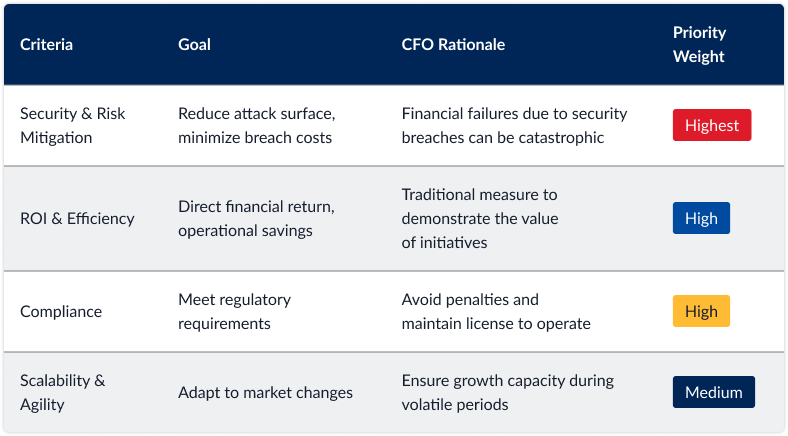
The CFO Technology Scorecard can help assess the strategic value of every major IT initiative.
It assesses investments based on key criteria, with Security & Risk Mitigation assigned the highest priority to protect the business. It also measures Return on Investment (ROI), Compliance, and Scalability & Agility to ensure spend is directed towards the most high-value initiatives.
Use this scorecard as a guide to assess various aspects of your clients’ IT strategies.
Forecasting: Short-Term Cost vs. Long-Term Efficiency
When strategically evaluating the costs and benefits of an IT initiative, it’s important to look beyond initial short-term costs and focus on total costs over a 3-5 year period.
This assessment can include explicit models to help understand the overall ROI of planned measures and productivity gains.
Technical Debt Reduction
Quantify the costs saved by replacing or modernizing a legacy system.
Often, upgrading a system can reduce future maintenance, integration, and complexity costs. It can also resolve security vulnerabilities and minimize frequent technical issues.
Productivity Gains
Understand the efficiency and productivity increase after implementing a new solution. Typically, this outweighs initial deployment costs.
The focus should be on improved performance, reduced errors, and faster processing time, and translating these results into clear financial value.
Migration vs. Build Costs
Compare the costs of migrating to a modern cloud platform versus the escalating cost of continually patching and extending an outdated on-premises platform.
This analysis should include the costs of ongoing patching, custom development, and hardware upgrades for the outdated system.
The goal should be to demonstrate the long-term savings of one avenue over another.
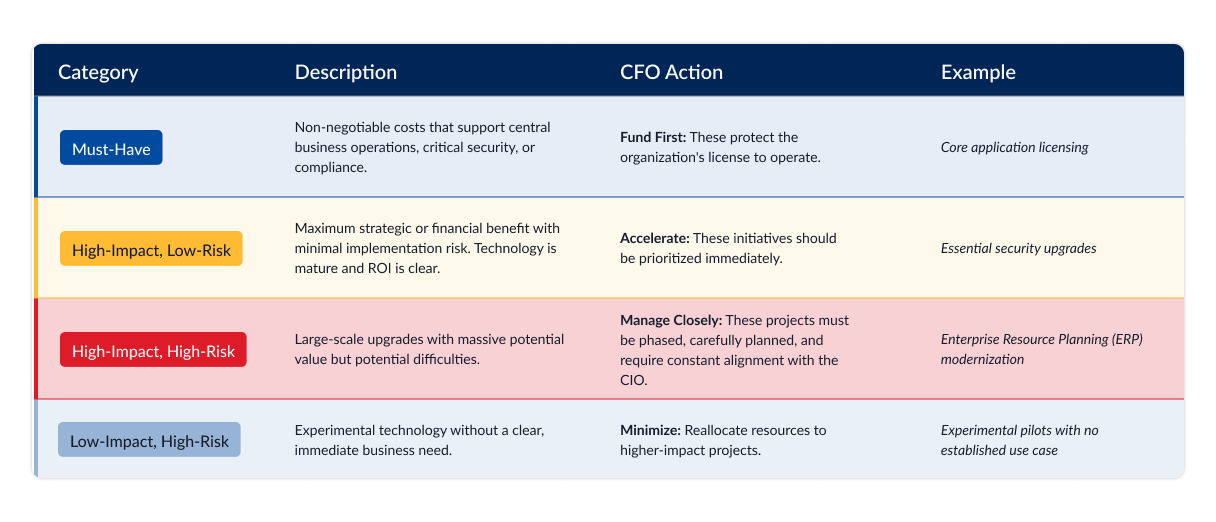
Prioritizing High-Impact, Low-Risk Initiatives
Categorize investments to identify those that offer maximum strategic or financial benefit with minimal implementation or operational risk.
This framework can help you identify and categorize specific IT initiatives to ensure resources are distributed to where they will result in the greatest returns for your client.
IT Governance & Cross-Functional Alignment
For a future-proof IT strategy to succeed, it must be supported by enterprise-wide governance and alignment.
With a robust structure in place, you can ensure technology investments match broader organizational goals, preventing siloed decision-making and inefficient spending.
You can be the critical driver of this alignment by moving IT from an isolated area of focus to an integrated aspect of the business. You can also collaborate closely with cross-functional teams to prioritize the right IT initiatives.
CFO-CIO Alignment
The fractional CFO’s partnership with their clients’ CIOs is the foundational partnership for modernizing IT.
You can provide the financial background (ROI, cost control, risk management) to ensure that all technology initiatives are financially justified and aligned with broader financial outcomes.
The CIO can provide the technical expertise for various expenditures, like an in-depth understanding of current systems, emerging technology solutions, and the feasibility of pursuing a particular path.
This alignment ensures that the IT strategy makes sense from a technical standpoint and maintains financial stability.
Collaborating with CIOs can turn IT expenses into planned, proactive investments and drive measurable business value.
Creating a Governance Rhythm (Monthly/Quarterly Reviews)
IT governance should be a consistent, formalized process, whether through monthly reviews or quarterly audits. Establishing a regular cadence is essential for effective oversight of IT expenditures and updates.
These reviews can include:
- Status updates
- Focused analysis of budget allocation
- Progress on high-impact and high-risk projects
- Progress on high-impact and high-risk projects
A regularly scheduled meeting time can also help your clients respond successfully to volatile economic shifts.
That way, the organization can make informed decisions and strategically scale the IT strategy up or down as needed.
Regular reviews can also bolster your collaboration with CIOs, allowing you to continue to communicate closely and work in tandem to prioritize the right IT initiatives.
KPIs and Performance Measurements
Fractional CFOs can play a critical role in measuring IT success and tracking the right metrics.
For instance, you can help your clients shift from tracking only technical IT metrics (uptime, support ticket resolution) to tracking financial and business-oriented Key Performance Indicators (KPIs).
Examples of relevant KPIs include:
- Efficiency: Operational cost savings through IT improvements
- Value: ROI score for major technology initiatives (see Technology Scorecard)
These business-centric metrics directly connect IT performance to the organization’s overall goals.
Quantifying these values ensures that your clients’ IT systems are continuously held accountable for their contribution to risk mitigation, financial health, and business value.
Vendor Assessment
A significant chunk of any IT budget is committed to third-party vendors and contracts.
To ensure proper oversight, there should be structured assessments of vendor performance, risk, and contract terms.
This analysis offers clarity as to whether IT budgets are being wasted on unnecessary resources and that contracts have the flexibility to scale up or scale down when needed.
Ongoing vendor assessment is an important part of IT budget optimization, helping your clients minimize costs and gain transparency into exactly what they pay for.
Creating a Flexible IT Operating Model
In order to achieve a truly future-proof IT strategy, fractional CFOs should advocate for a flexible IT operating model.
This is more than a methodology; instead, this model shifts how IT is structured and budgeted. As a result, IT costs can move from a rigid, slow-moving expense to a flexible, key contributor to business value.
Why Agility Matters for Economic Shifts
During periods of economic volatility, businesses need to be able to shift their approach and scale up and down as needed. With a rigid IT model, it might take months to approve a project, obtain resources, and implement a solution.
In contrast, an agile model helps businesses scale IT resources accordingly during growth periods and downturns.
These changes can occur while maintaining critical security measures and business continuity.
Flexibility is key to effective IT budget optimization and risk management during periods of uncertainty.
Building Workflows for Rapid Response
If you want to help your clients achieve IT agility, streamlining decision making and deployment processes is pivotal.
To reach this goal, it may be necessary to restructure current operational processes.
Shifting to cross-functional sprints is a key part of this change. These work cycles can integrate feedback from multiple teams like IT, finance, and operations, so that high-impact projects can be completed quickly.
Your clients can design workflows that enable continuous deployment and work, empowering teams to respond to new cyber threats or sudden opportunities in days, not months.
With this approach, all perspectives are accounted for from the beginning, reducing approval periods and delays due to revisions.
As a result, your clients can build competitive advantage and be better prepared to defend against new risks.
Leveraging Automation and RPA to Maintain Agility
Automation and AI are crucial ways to simplify various aspects of the IT deployment process and ongoing management.
Your clients can automate deployment, testing, security patching, and infrastructure scaling, freeing up employees to work on other high-level, complex tasks.
Automation can also lower the cost of change by making it easier to scale up or down. For instance, automating cloud resource usage can help your clients easily adapt in real time to changing requirements.
In addition, automation can reduce friction and improve your clients’ ability to quickly adopt new technologies.
Over time, this leads to greater productivity and operational cost savings.
Continuous Improvement Cycle
An agile operating model is defined by ongoing optimization; it shouldn’t be static. This approach ensures the strategy remains relevant as the technological landscape and the economic conditions change.
This process involves continual review of IT performance, moving beyond technical metrics to focus on business-oriented KPIs. Measuring the ROI of past and current technology investments can also help understand successes and areas of improvement.
Another important step is to identify new opportunities that represent additional efficiency gains or risk reduction.
By assessing IT performance in this way, IT strategies remain dynamic and can be continually refined. Prioritizing ongoing optimization helps your clients build a resilient and aligned IT structure that supports them for years to come.
Checklist: CFO’s Quick Guide to a Future-Proof IT Strategy
Use this checklist to gain a baseline assessment of the current state of a company’s IT functions and align them with financial objectives and broader organizational goals.
- Assess IT Maturity: Is IT viewed as a reactive expense, or a strategic, proactive investment? Shift the perception and function of IT towards enterprise-wide digital value creation.
- Assess IT Maturity: Is IT viewed as a reactive expense, or a strategic, proactive investment? Shift the perception and function of IT towards enterprise-wide digital value creation.
- Review Security Posture: Formally evaluate the organization’s security posture and understand vulnerabilities, with a goal of building a zero trust architecture and security-centric culture.
- Score Technology Investment Value: Apply the CFO Technology Scorecard to major IT initiatives. Quantify investments based on Security & Risk Mitigation, ROI/Efficiency, Compliance, and Scalability.
- Evaluate Investments for Technology Scalability: See how IT investments will help the business as it adapts and changes. Make sure there’s a transparent understanding of current technologies and how they contribute to overall scalability.
- Verify Compliance Requirements: Confirm that all core systems are continually updated and aligned with relevant standards (HIPAA, PCI, etc). The goal should be to help ensure compliance and reduce the likelihood of regulatory penalties.
- Review Readiness for AI/Automation: Identify and prioritize opportunities for AI-driven automation to speed up IT processes. This change can lead to operational cost savings and productivity gains.
Why Partnering With an Expert IT Strategy Provider Accelerates Success
Working with an expert IT strategy consulting provider is one way to make sure your clients are on the right path to creating a resilient, future-proof IT strategy.
Discover the advantages of working with a seasoned partner and the tangible benefits your clients will receive.
Faster Implementation
Working with external IT experts gives you and your clients access to specialized knowledge regarding IT strategy development.
This results in faster deployment, as these experts are skilled at building and implementing forward-thinking IT strategies. They often have proven methodologies in place, allowing them to bypass setbacks that you may experience by working alone.
Your IT partner should also have established vendors who can help streamline the process, saving time for your clients.
Better Governance
A trusted IT provider will have structured frameworks in place for overseeing IT strategy creation and any changes over time. They can also help formalize the collaboration between your role and your clients’ CIO, helping to ensure technical and financial decisions are aligned.
This external perspective enables continual reviews of IT expenses, project status, and future goals.
The right partner will guide your clients in tracking financial and business-oriented KPIs in addition to technical metrics.
Predictable Spending
Working with a trusted IT partner also helps ensure predictable spending for your clients.
Most IT providers operate on a fixed-cost subscription-based model, which can easily be incorporated into your clients’ budgets.
This removes the costs of reactive IT spending, like emergency repairs or unplanned support.
Instead, all necessary services are included in one single, predictable monthly fee.
Due diligence is still the order of the day; because every provider is different, make sure you understand exactly what is covered in the contract and what work may be excluded.
In-Depth Expertise
The most experienced providers will have created many IT strategies before, and can help each client prioritize the best IT initiatives for their business.
They will also bring a deep understanding of best practices and be able to guide your clients in the right direction.
Plus, the right IT partner will be familiar with your client’s industry, giving them proven insights into the right choices to make to stay ahead in the competitive landscape. This specific background gives them proven knowledge of relevant compliance requirements, the best technology solutions, and emerging trends.
Look for IT partners that create comprehensive solutions tailored specifically to your clients’ needs and industries.
Proven Track Record
Any strong IT partner should have a wealth of experience and proof of success; this can be found in client reviews, testimonials, and references.
Make sure you carefully review this information for any shortlisted IT vendors. Speaking to real customers can give you a genuine understanding of the IT provider’s role as a strategic technology partner.
Another area to review is the client’s success stories. Do they work with businesses in your clients’ industries? What were the results of those partnerships?
Make sure the provider has enough years of experience to understand the rapidly changing tech landscape and how your clients can best adapt.
Final Thought

In today’s rapidly changing world, building a future-proof IT strategy requires clear frameworks, in-depth expertise, and a flexible approach.
As a fractional CFO, your role is especially significant, as you have to balance the need for measurable ROI with adequate IT risk management.
Taking a structured, criteria-based approach can help your clients make the best decisions that support strong cybersecurity practices, ensure IT agility, and maintain competitiveness.
Make sure that your clients’ IT strategies reflect the changing economic landscape and technology trends so they can stay up to date in their industry and build security amid changing market conditions.
Above all, remember that IT is not a cost center, but a strategic growth vector.
Need more personalized support to build your future-proof IT strategy? Contact our IT experts today to set up your no-cost consultation.
Frequently Asked Questions
Why should fractional CFOs be involved in strategic IT planning?
The fractional CFO’s strategic planning work has expanded far beyond traditional finance duties. You should be involved with overall IT strategy creation, including planning IT investments, ensuring all costs directly support broader objectives, providing a strong measurable ROI for items, and prioritizing risk mitigation.
These efforts require close collaboration with your clients’ CIO to choose and rank the best investments. Your role as a fractional CFO is crucial to building a strong digital transformation strategy, shifting IT from a cost center into a critical contributor of value.
How does economic volatility impact IT spending decisions?
Economic volatility leads to budget unpredictability, rising labor and technology costs, and supply chain disruptions.
It calls for a shift towards flexible budgeting models like rolling forecast and zero-based budgeting. These approaches allow organizations to scale spending up or down rapidly without sacrificing critical security initiatives or long-term strategic projects.
What technologies should fractional CFOs prioritize in 2026 and beyond?
CFOs should prepare for the financial and operational impact of the following technologies:
- Generative AI & AI Copilots: These solutions streamline tasks and lead to significant productivity gains and a focus on more meaningful work.
- Zero Trust Security: This approach mitigates risks by following a “trust no one” mindset; these models may become more centralized in 2026 as more organizations embrace single sign-on processes.
- Edge Computing: This model allows for real-time data processing to speed up business and financial decision making.
- ERP Modernization: Shifting from on-premises solutions to predictable, cloud-native environments can reduce technical debt, centralize data analysis, and reduce costs.
How can fractional CFOs measure the ROI of technology investments?
Fractional CFOs can use an objective framework based on two components:
- The CFO Technology Scorecard: Evaluate investments based on four weighted criteria: Security & Risk Mitigation, Return on Investment (ROI) & Efficiency, Compliance, and Scalability & Agility.
- Forecasting: Conduct a Short-Term Cost vs. Long-Term Efficiency analysis that quantifies:
- Technical Debt Reduction (savings from replacing or modernizing a legacy system).
- Productivity Gains (translating efficiency gains into financial value).
- Productivity Gains (translating efficiency gains into financial value).
- Migration vs. Build Costs (comparing the cost of cloud migration to the rising costs of maintaining legacy platforms).
What role does AI play in a future-proof IT strategy?
AI is a critical component for both growth and defense as part of a broader IT strategy.
- Efficiency: AI-driven automation and RPA (Robotic Process Automation) are core to the Workforce & Process Automation pillar, leading to significant operational expense savings and productivity gains.
- Growth: Generative AI & AI Copilots are projected to streamline higher-value human tasks, modeling, and reporting.
- Risk Mitigation: AI can be used for advanced threat detection as part of a Security-First Architecture.
What risks threaten an IT strategy during economic downturns?
Failing to modernize IT systems exposes your clients’ businesses to major IT risks, including:
- Productivity Loss: Slow, aging end-user devices and outdated systems can reduce employee productivity and lead to expensive annual costs.
- Security Vulnerabilities: Unsupported environments and unpatched software can expose your clients to major security vulnerabilities that can be exploited by bad actors.
- Technical Debt: Over time, making quick, subpar technology decisions can add up and result in high long-term costs and unnecessary system complexity.
- Legacy System Maintenance Inflation: The cost of maintaining old systems is often higher than the cost of a planned upgrade.
- Compliance Penalties: If systems are too dated, they can fall out of alignment with evolving regulatory standards. Failing to upgrade business systems can open your clients up to the risk of regulatory penalties if their business occupies a regulated industry.
- Customer Churn: In today’s fast-paced business landscape, customers expect simple, streamlined online experiences. Outdated, slow IT can dissuade customers from working with businesses and lead them elsewhere.
How often should a business update its IT strategy?
An IT strategy should be a “living” document, not a static plan, and should be continually updated. This can involve establishing consistent monthly or quarterly reviews to monitor IT performance, measure ROI, and ensure continuous alignment with changing market trends and overall business goals.