


Key Points
- This Guide Covers: Learn what Answer Engine Optimization (AEO) and Generative Engine Optimization (GEO) are, how they differ from traditional SEO, and how AI-powered search engines like Google AI Overviews, ChatGPT, and Gemini discover, evaluate, and cite content.
- Top Solutions: Create E-E-A-T-driven content, implement schema markup, build topic clusters, strengthen internal linking, and maintain technical SEO best practices to improve AI visibility and citations.
- Key Evaluation Factors: Prioritize content quality, semantic relevance, trustworthiness, structured data, crawlability, user-focused organization, and consistent brand authority across digital channels.
- The Miles IT Advantage: Miles IT combines SEO, AEO, and GEO best practices to develop AI-ready content, optimize technical performance, strengthen topical authority, and help businesses increase AI citations, organic visibility, and qualified traffic while adapting to the future of AI-powered search.
“Change brings opportunity.”
Whether you’re refreshing your brand or implementing a new strategy, change can lead to incredible results—including presence in AI search results, if you’re a marketer.
As SEO evolves, AI search optimization is a new signpost on the map that involves updating website content to appear in AI-powered search results.
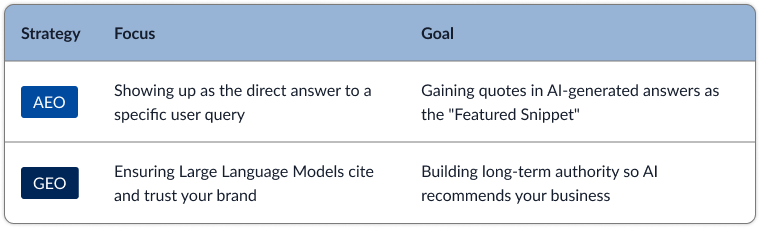
These strategies are known as Answer Engine Optimization (AEO) and Generative Engine Optimization (GEO). While these terms are sometimes used interchangeably, there is a difference:
- AEO involves optimizing content to be the direct answer for a specific question
- GEO focuses on helping AI engines cite your content as an authoritative, trusted resource
In the past, prospects found your business by typing queries into search engines. The higher your website ranked, the better chance you had of being found.
Now, though, AI-powered search results and tools like ChatGPT and Gemini are changing the game, and businesses need to adapt in order to stay competitive. Google’s AI Overviews now reach more than 1.5 billion monthly users, highlighting how rapidly AI-powered search is becoming a primary way people discover information. Businesses must adapt to remain competitive.
Read on to explore why AEO and GEO strategies require evolving your approach beyond traditional SEO and how your organization can stay ahead by optimizing for AI search.
What are Answer Engine Optimization (AEO) and Generative Engine Optimization (GEO)?
Answer Engine Optimization (AEO) and Generative Engine Optimization (GEO) are digital marketing strategies that focus on being the definitive answer in AI-powered searches. According to Deloitte, 83% of enterprises believe generative AI will fundamentally change customer discovery, making AI search optimization increasingly important.
These practices shift away from traditional SEO practices that only aim for high search engine rankings. If businesses truly want to optimize for AI search, they must aim to build expertise in both of these areas.
Remember this: for decades, search engines functioned in the same way.
Users typed in queries, and Google responded with a list of websites to answer those questions, ranked by relevance and authority.Nearly 65% of Google searches now end without a click, driven largely by AI Overviews, featured snippets, and instant answers.
In today’s AI-powered world, though, we’re moving away from a list of ranked pages toward sophisticated answer engines.
While users still sometimes enter queries into search engines, Google now shows AI-powered answers in addition to the traditional results. Many queries are now entered directly into AI chat tools like Gemini and ChatGPT rather than Google itself.
To stay visible, your business can no longer exclusively rely on traditional SEO; you must also leverage AEO and GEO if you want to appear where prospects are searching.
It’s best to think of AEO and GEO as an evolution of traditional SEO, not a replacement.
What is Answer Engine Optimization?
Answer Engine Optimization (AEO) enhances content to be the definitive answer to specific user questions.
The primary goal of AEO is to have your content quoted as the direct AI-generated answer or featured snippet for a specific search.
AEO leads to a higher amount of zero-click searches, where users get direct answers on a search engine or AI platform without visiting another website.
How Do “Zero-Click Searches” Affect My Marketing?
“Zero-click searches” may represent a decrease in the number of users clicking through to your website due to the rise of AI-generated overviews and summaries. Although AI Overviews can reduce organic click-through rates by 30–35%, earning citations within AI-generated answers often increases brand authority and visibility among high-intent users.
However, by taking steps to follow AEO and GEO best practices, you can increase AI citations for your business and establish yourself as a credible, helpful resource.
If users view you as a valuable thought leader, they may be more likely to visit your website.
While users who only need quick information may get their answer on the results page and then navigate away, those looking for a service or product will still need to visit your company’s website to contact an expert or make a purchase.
What are Examples of Answer Engine Optimization?
Consider this example of AEO on Google, with the query of “what is the best brand of dog food for small dogs.”
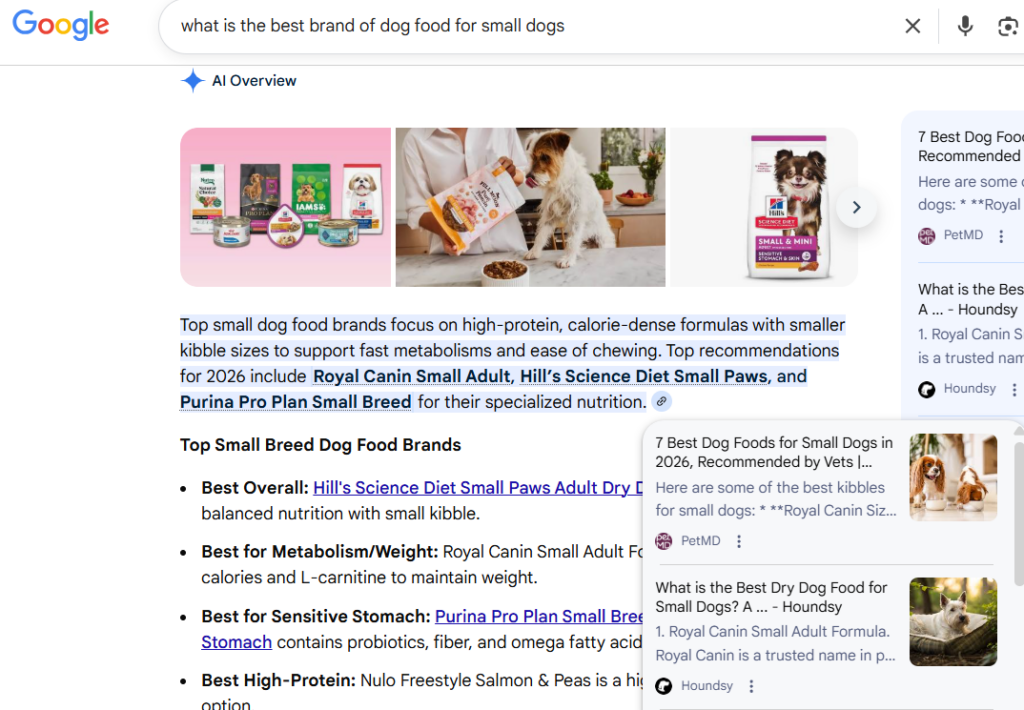
In the example above, you can see how Google’s AI Overview provides AI-generated sources by pulling from reputable websites like PetMD and Houndsy that directly answered the query.
The generated response also linked to other sources as it compared different brands of dog food.
Some users won’t click on those links at all, however. In a 2025 study, the Pew Research Center found that just 8% of users clicked on a link provided in search results when an AI summary was present.
In contrast, 15% of users—almost double the amount—clicked on a link in search results when an AI summary was not there.
While this focus on AI-generated answers may mean a decrease in clicks to your website, the value of a citation is far greater.
Benefits of Citations in AI-Generated Answers:
- Highly qualified users already considering your products and services clicking through to your website
- Improved authority in search results
- Increased visibility in AI content
Did you know? According to Search Engine Land, AI Overviews can show up in as many as 25% of user searches.
What is Generative Engine Optimization?
Generative Engine Optimization (GEO) is a broad strategy that helps LLMs cite your resources and view your business as a trusted primary source.
The goal of generative engine optimization strategies is to build long-term authority and recognition with AI platforms. That way, these AI models are more likely to recommend your content and draw on your expertise. The goal of GEO is to build long-term authority with AI platforms. This is increasingly important as ChatGPT now serves more than 800 million weekly active users, making AI visibility a growing source of brand discovery.
What are Examples of Generative Engine Optimization?
Consider this example of GEO on ChatGPT, with the same query as the one in the AEO example.
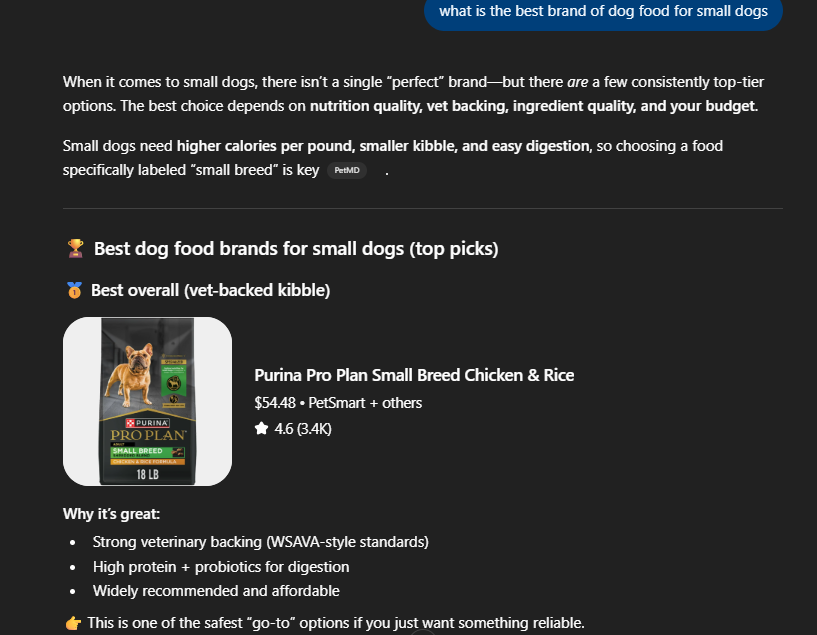
Similar to Google, ChatGPT cited PetMD early on in its response. It also cited other sources throughout the answer and generated a large list so users could compare top brands.
It’s important to note that searches using generative AI platforms are expected to increase. In fact, the volume of ChatGPT prompts soared almost 70% in a six-month period in 2025.
Users are also finding more efficiency when they utilize AI-powered search engines. Their high satisfaction rates reflect that this approach is here to stay and not just an overnight trend.
Ultimately, the foundation of AEO and GEO is the same as traditional SEO: it all starts with strong, cite-worthy content. You want search or answer engines to easily crawl your website and determine your perspective as helpful.
The key difference is that today’s users are looking for specific answers instead of only links to sources, making it essential to optimize for AI search through quality content.
AEO vs. SEO: How Are They Different?
In summary:
- SEO targets high rankings in search engine results
- AEO targets recognition as the definitive answer for a specific query
- Strong authority and high-quality content are key for both
SEO focuses on gaining high rankings in search results that lead to website click-throughs, while AEO focuses on honing content to be the definitive answer for a specific user query.
Consider this example of SEO for a user searching for “best accounting software for nonprofits.”
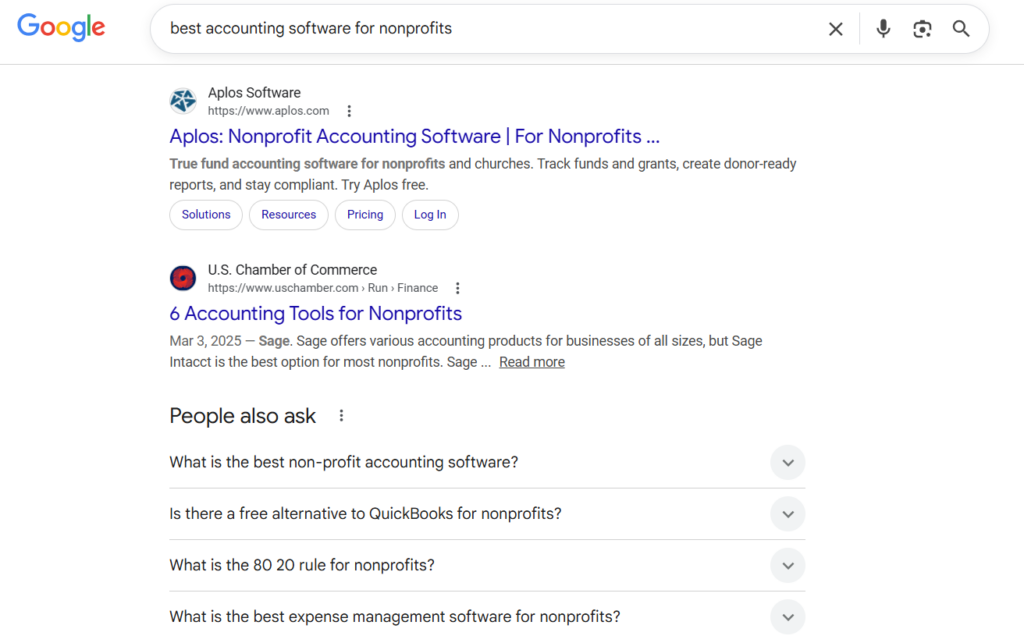
In this example, you can see that the highest-ranked websites are a specific type of nonprofit accounting software and a roundup of the best accounting tools for nonprofits.
From there, users can explore related questions in the “People Also Ask” box, like “Is there a free alternative to QuickBooks for nonprofits?” and “What is the best expense management software for nonprofits?”
Now, let’s look at an example of AEO for the same query.
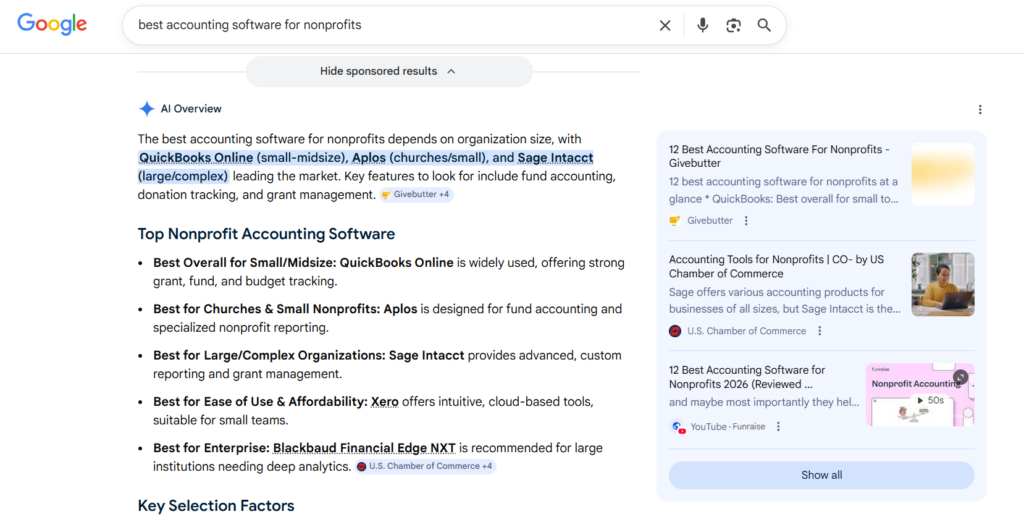
In this example, you can see that Google’s AI Overview shares specific recommendations that answer the query immediately.
Based on multiple sources, the answer suggests choosing accounting software based on organizational size, with options including QuickBooks Online for SMBs, Aplos for churches and smaller businesses, and Sage Intacct for large, complex organizations.
From there, users can read key selection factors or explore the sources in more detail.
These differences between SEO and AEO reflect a change in user behavior as people move away from exploring links to gaining direct, AI-generated answers.
AI-powered search platforms like Google’s AI Overviews, ChatGPT, and Gemini contribute to this evolution.
The Zero-Click Reality
Research shows that 60% of Google searches worldwide lead to no clicks.
With AI-generated answers displayed directly in front of them, fewer people are exploring websites to find solutions.
To combat decreased click-through rates, you’ll want to have your brand quoted as a “featured snippet” or definitive answer to boost visibility and authority.
Keep in mind that AEO is an evolution, not a replacement, for traditional SEO. Core SEO principles like technical structure, crawlability, and trustworthy content are still key.
Tip: You need a strong SEO foundation and presence in search results if you want to optimize for AI search.
How Do AI Search Engines Work?
In summary:
1. AI platforms use crawlers to index and categorize content, relying on search engines to pull info from reputable sources.
2. Next, the AI models are trained on the data to learn patterns and structures so they can analyze information and create relevant responses.
3. “Query fan-out” divides questions into subtopics and broadens the search across multiple sources.
4. AI models rely on authoritative sources to generate answers, prioritizing credible content that anticipates follow-up questions.
AI search engines combine traditional search engine models with Large Language Models (LLMs) to leverage semantic search, shifting from link discovery toward contextual answer delivery.
Crawling and Indexing
Like regular search engines, AI platforms use crawlers like Googlebot and Bingbot to find and categorize web content.
These crawlers prioritize the most valuable URLs to determine which content will be most helpful to users.
Many AI models rely on search engines like Google to gather information and pull from trusted sources.
Instead of viewing these AI tools as separate from Google or Bing, think of them as search engine partners.
“Query Fan-Out”
After indexing, LLMs train on the data to learn patterns and structures, analyze information, and create new, comprehensive responses.
One feature is “query fan-out,” which divides the question into subtopics and expands the search across multiple sources.
Citation and Trust
AI systems are designed to provide factually supported answers, with responses backed by high-quality web content.
Any AI-generated (“Zero-Click”) answer directly relies on recognizing and citing authoritative sources.
To determine which sources are reputable enough to cite, AI engines prioritize credible, comprehensive content that anticipates follow-up queries surrounding a particular topic through query fan-out.
How Do You Optimize Content for AI Search Engines?
Creating authoritative, highly structured, and technically sound content is crucial for AI search optimization.
Following these best practices can increase your probability of being cited by an AI search engine.
1. Establish Credibility and Semantic Authority
In summary:
- Demonstrate E-E-A-T (Experience, Expertise, Authority, and Trust) principles
- Target long-tail and semantic questions
- Build topic clusters
- Write for humans first
Cited content usually features proof of expert authorship and provides a comprehensive, credible overview of a topic.
Demonstrate E-E-A-T (Experience, Expertise, Authority, and Trust)
Like search engines, AI engines prioritize content that reflects E-E-A-T principles.
To meet these goals, incorporate the following best practices into your content:
- Original research
- Helpful data
- Expert quotes from Subject Matter Experts (SMEs)
LLMs can’t invent these types of insights, so they rely on trusted sources (like your business) for in-depth, factual information.
Target Long-Tail and Semantic Search
Move beyond exact-match keywords to cover the full, conversational queries of your audience. You can think of this as covering a user’s full thought process.
Semantic searches are AI-powered, moving beyond matching keywords to understand search intent and context and produce more helpful results.
For example, “ice cream vs. frozen treat” is one example of semantic search; the answer or search engine would understand that the two categories are related even though they don’t use the same keywords.
Search engine features like Google Autocomplete and “People Also Asked” can help you understand real-world questions.
You can also use SEO and AEO visibility tools like Semrush and Ahrefs to research specific topics in greater depth.
Build Topic Clusters
Create an interconnected web of related content pieces for a particular subject to demonstrate your expertise, both for AI models and human readers.
Many businesses have already been creating topic clusters for SEO purposes, utilizing “pillar pages” that cover topics in depth and link to more focused articles.
If AI views your business as a trusted authority on a specific topic, you’ll be more likely to appear in related responses.
Write for People First
Maintain a human-centric focus for every piece of content you create by prioritizing readability and user engagement.
Showing up in search results isn’t about keyword stuffing; it’s about creating valuable, compelling content that solves a reader’s problem.
2. Optimize Content Structure and Clarity
In summary:
- Answer the question immediately
- Create clear, concise content
- Use clear visual hierarchy (H1s/H2s, bulleted/numbered lists, tables)
- Share short summaries
- Keep content sections short and focused
- Bold key takeaways
- Update content regularly to keep it fresh
Content must be easily scannable and understood if you want to optimize for direct AI answers or featured snippets.
Answer the Question Immediately
Make sure you answer specific questions within the first 50–100 words of a section. This structure makes it easier for AI tools to scan and understand your content.
From there, you can provide additional background information and details to support the answer.
Tip: In 2026, if you can’t answer a customer’s question in 50 words, an AI engine will find someone who can.
Use Clear Visual Hierarchy
Utilize H2 and H3 headings as a roadmap for AI crawlers. Bulleted or numbered lists and tables can also significantly improve readability for AI engines (and for human readers, too).
When breaking up content, make sure that every paragraph is focused and can stand on its own.
Share Short Summaries
Place a short summary block at the beginning or end of sections to help AI crawlers quickly understand the meaning of your content.
This approach can also help summarize your perspective for human readers who don’t have time to read an entire article.
Create Short, Focused Content Sections
Move away from large blocks of text and break down information into digestible sections that are easy to understand. Keep paragraphs short and focused on one specific idea.
Bold Key Takeaways
Emphasize key facts, statistics, and direct answers to add value for both human readers and AI crawlers.
For human readers, bold text significantly improves readability and understanding.
For AI crawlers, it acts as a powerful signal, making it easier for the model to pull specific information from your content as a direct AI-generated answer.
Update Content Regularly
Regularly updating your existing articles shows AI models that your knowledge is up to date and complete.
Like traditional search engines, AI engines prioritize fresh, recent content.
This approach can contribute to the success of long-term generative engine optimization strategies so that your content always stays aligned with evolving user questions.
3. Build Technical Foundations
In summary:
- Use advanced schema markup
- Optimize technical elements
- Follow internal linking best practices
- Review your robots.txt file
Implementing the right technical elements results in structured data that AI models can use to categorize and trust your content.
Advanced Schema Markup
Use FAQ, How-To, and Article schema to act as “translators” that give AI structured data it can easily parse.
Technical Hygiene
Fast page load times and mobile responsiveness still matter in 2026, as they signal trust to AI models.Fast page load times remain essential because 53% of mobile visitors abandon pages that take longer than three seconds to load, affecting both user experience and AI trust signals.
Other elements of technical SEO are important, too—make sure you find and resolve broken links and have an up-to-date, functioning TLS certificate (previously, this was the SSL certificate, but the term SSL is still used even though TLS is the secure, modern successor to it).
Internal Linking
Create a logical content structure using internal links to guide AI bots (and readers) deeper into related content.
Having a comprehensive web of interconnected topics (like topic clusters for SEO) strengthens your site’s overall authority.
Why is internal linking valuable for search engine and AI engine crawlers?
Internal linking helps Google and AI engines understand the different topics on your website, build connections between various web pages, and establish credibility.
This strategy helps both users and search and answer engine platforms find relevant pages on your website and understand context. That way, they can draw on your content as a source in AI-generated answers or rank your content on a Search Engine Results Page (SERP).
Curious about internal linking best practices? Check out our blogs on internal link structure and link optimization.
Review Your robots.txt File and Consider an llms.txt File
Access matters if you want LLMs and AI engines to read your content. Review your robots.txt file to check and resolve AI agent disallows.
Some sites are also now using an llms.txt file, which is meant to provide information that is AI-friendly and easily digested by LLMs.
Anthropic, the company behind the AI tool Claude, has published an llms.txt file on their own website.
However, while this suggests that at least one AI company could be open to the concept of this file, the use of llms.txt is currently speculative. Marketers are adopting it although they don’t yet know if AI tools will actually use it.
4. Create Visual Trust & Use Multimedia
In summary:
- Create helpful infographics or diagrams with detailed captions
- Use short-form videos with complete transcripts
High-quality multimedia content can reinforce trust in your business and brand for both users and AI models.
Create Helpful Infographics
Summarize key points in an infographic that AI platforms can reference. Always add alt text to improve accessibility and provide key signals for AI platforms.
Use Short-Form Video or Diagrams
Explain key concepts using detailed diagrams or helpful videos. Detailed captions or complete transcripts can serve as another AI signal.
5. Map Content to the Buyer’s Journey
In summary:
- Focus content on the three stages of the buyer’s journey (Awareness, Consideration, Decision) to better align with real audience questions
Centering content around the three stages of the buyer’s journey ensures your content aligns with real questions your target audience is asking.
A 2026 Gartner survey revealed that 31% of US consumers spend more time searching for information thanks to the advent of AI summaries.
As a result, providing high-quality, researched content is essential to help users make the most informed decisions.
Consider the following content examples and how they can help your audience throughout their research process.
|
Buyer Stage |
Optimization Goal |
Example Content Focus |
|---|---|---|
|
Awareness |
Establish your brand as the primary source of knowledge and build foundational trust with AI models. |
“What is Enterprise Resource Planning (ERP) and How Does It Connect Business Functions?” |
|
Consideration |
Compare leading solutions to position your firm as a trusted authority. |
“Lease vs. Buy: A Full Financial Comparison for Construction Equipment Acquisition” |
|
Decision |
Deliver proof of reputation and performance. |
“Case Study: How a Regional Distributor Reduced Fuel Costs by 15%” |
Mapping content to the buyer’s journey is one strategy to optimize for AI search and answer the questions your customers are asking at every stage of the funnel.
How Can Content Distribution and Brand Recognition Help with AI Search Optimization?

In summary:
- Participate in conversations on platforms like Reddit, Quora, and LinkedIn to drive brand recognition
- Repurpose content across platforms to increase trust signals for AI engines
- Avoid exaggerated claims and clickbait-style articles
For AI platforms to trust and cite a source, they need to evaluate and confirm its online reputation.
How can I strengthen my online reputation to optimize for AI search?
Make your business part of the conversation by sharing content and participating in discussions on platforms like Reddit, Quora, and LinkedIn.
Generative AI models regularly use these platforms as data sources. In fact, a June 2025 study found that 40% of AI search citations can be traced to Reddit.
Encourage your customers to contribute to these online forums, too. User-generated content directly influences AI sentiment and serves as a powerful trust signal.
How does content repurposing strengthen my brand’s presence in AI search?
Content repurposing creates signals of relevance across the internet, serving as a key component of GEO.
Distributing assets across multiple platforms helps AI models encounter consistent, trusted information about your business’s expertise in many different places and formats.
A single, high-performing blog post can be converted into multiple assets, such as a LinkedIn newsletter, an infographic, or a video script.
This redundancy strengthens your authority in the eyes of AI, increasing the chances of gaining a citation in an AI search result.
What types of content are rewarded in the eyes of AI search?
As you publish content, avoid clickbait-style headlines and exaggerated assertions to protect your reputation and build credibility.
AI engines are becoming more savvy at identifying overdramatic titles, misleading content, and exaggerated claims. These types of content often lack E-E-A-T principles.
In the AI era, helpfulness and clarity are rewarded and clickbait is increasingly penalized.
How do I build brand authority and credibility?
Building authority and credibility for Answer Engine Optimization (AEO) and Generative Engine Optimization (GEO) requires a focused strategy that maximizes content visibility in AI search.
Backlinks from Reputable Sites
When another business links to your website, it serves as a “digital endorsement.” These backlinks serve as third-party validation signals to LLMs that your content is valuable and trusted.
Original Research and SME-Driven Content
Publish original insights from Subject Matter Experts (SMEs) and leverage your firm’s years of experience to provide insider knowledge.
AI models cannot replicate the years of expertise developed by your team. With this approach, platforms can recognize your business as a reputable, trusted source of information.
Use Verifiable Data Points
Whenever possible, back your claims with accurate data or industry success markers.
These data points act as factual evidence that AI can cite in their responses instead of relying on qualitative content alone.
Cite Credible Sources
Just as AI prioritizes trustworthy sources, you should, too.
Reference high-quality, reputable sources throughout your content to show that your resources are well-researched and responsible.
Consistent Branding Across Channels
Uniformity matters. Take steps to showcase consistent messaging across your website, business profiles, and social media.
Brand consistency helps Google and AI platforms confidently link all mentions of your business back to a single, trusted “brand entity.”
What is a brand entity and why is it important for GEO?
A brand entity represents a specific identity that both search engines and users can recognize across platforms.
It includes more than just a company name, but also encompasses aspects like mission and reputation to help search engines and AI engines make the best recommendations.
Collaborate With Industry Thought Leaders
Partnering with recognized experts can also increase brand mentions and signal your business’s relevance to AI.
Possible Collaboration Strategies
- Co-authoring articles
- Conducting and publishing interviews
- Featuring external experts in your content
All of these strategies can signal that your brand actively contributes to the industry conversation.
By implementing these tactics, you can actively build a strong digital reputation and increase your chances of citation in AI search.
AI Search Engine Optimization Checklist
Keep your AI search strategy top of mind. Download our free checklist so you can reference these tips at any time.
Staying Ahead in an Evolving AI Landscape
Today’s answer engine optimization and generative engine optimization strategies show that while the “rules” of search have changed, the core objectives remains the same:
- Be the most helpful, credible resource for your customers
- Answer the most relevant questions in a human-friendly manner
- Build a trusted reputation across platforms.
These strategies represent an evolution of traditional SEO, not a replacement.
If AI platforms trust your business enough to cite you in search results, you win authority and long-term visibility—even if click-throughs from SERPs decrease.
Miles IT helps clients stay ahead of critical shifts in the search landscape through our best-in-class digital marketing services. We work to implement forward-thinking strategies that help businesses optimize for AI search.
If you’re interested in optimizing your website, content, and brand to show up in AI search results, our marketing plans include key services that can help with this.
Ready to optimize your online presence and boost recognition in AI chats? Request a free consultation with our marketing team today.
FAQs
Is traditional SEO dead?
Not at all. Answer engine optimization (AEO) and generative engine optimization (GEO) represent an evolution in SEO.
A strong SEO foundation is crucial if you want to explore AEO and GEO efforts. A technically sound website that follows SEO best practices is often the first step in any AEO or GEO strategy.
How long does it take to see results in AI search?
Like SEO, you can’t expect results from AEO or GEO overnight. However, some efforts, like featured snippet optimization, can lead to wins or citations in AI engines in as little as 30-60 days.
Is AEO/GEO only for larger companies with huge budgets?
AEO and GEO actually level the playing field for SMBs. High-quality content leveraging SME insights often scores higher than a generic corporate landing page in AI results.
For SMBs, GEO and AEO are about targeting the right audiences with highly specific content. This focused approach allows SMBs to build authority in their niche and reach highly qualified prospects.
Will AEO/GEO reduce my website traffic?
Not necessarily. While user behavior is changing, AEO and GEO help you capture the most qualified traffic in a world where fewer and fewer users are clicking links on search engine results pages (SERPs).
If you lean into this new era of search instead of ignoring it, you’ll gain more visibility in AI search results instead of letting competitors take the top spots.
How do I know if AI is citing my business?
You need to shift from tracking traditional keyword rankings to actively monitoring brand mentions and citations within AI tools. This requires tracking mentions directly in AI search results.
Tools like Semrush and Ahrefs can also help you examine your business’s presence in AI platforms. Monitoring these brand mentions is key to proving the ROI of AEO and GEO efforts.
AI chat tools also include UTM parameters on the links they provide, feeding information on the source into Google Analytics when users click these links and visit your website. This is a free alternative to Semrush and Ahrefs to give you insights into how much traffic your site is getting from AI chat.
Why is GEO important for B2B companies specifically?
For well-established B2B companies, Generative Engine Optimization (GEO) is a powerful way to showcase credibility and trust. These days, decision-makers are looking for trusted advisors who can serve as their long-term partner, not just generic vendors.
When an AI platform cites your company as the authority on a specific industry question, it serves as a digital endorsement that puts your brand top-of-mind and instills user trust.
How do you structure a page for AEO?
Page structure should focus on clarity and scannability, ensuring the content can be easily parsed by AI search engines. Key elements include:
- Answer the Question Immediately
Answer specific questions within the first 50–100 words of a section. You can provide supporting background details afterwards.
- Use Clear Visual Hierarchy
H2 and H3 headings serve as a roadmap for AI crawlers. Bulleted lists, numbered lists, and tables also significantly improve readability for both AI engines and human readers.
- Create Short, Focused Content Sections
Break down information into digestible sections rather than large blocks of text. Keep paragraphs short and focused on a single idea to boost understanding.
- Share Short Summaries
Include a short summary block at the beginning or end of sections to help AI crawlers quickly grasp the content’s meaning.
- Bold Key Takeaways
Emphasize key facts, statistics, and direct answers using bold text. This acts as a powerful signal for AI crawlers, making it easier for the model to pull specific information as a direct answer.
- Update Content Regularly
Consistently update existing articles to show AI models that your resources are accurate and up to date.
Related Topics
- Ultimate Guide: SEO Standards and Best Practices
- Ultimate Guide: Content Marketing 101
- Why Content Has a Huge Role in SEO (And How to Optimize It)
- All You Need To Know About Technical SEO And How to Improve It
Article Recap
How to Optimize for AI Search: AEO & GEO Strategy Guide (2026)

Key Takeways
- This Guide Explains: The differences between Answer Engine Optimization (AEO), Generative Engine Optimization (GEO), and traditional SEO, and how AI-powered search engines discover and cite trusted content.
- Building a Strong Foundation: Build a strong AI search presence with E-E-A-T, semantic content, schema markup, topic clusters, internal linking, technical SEO, and consistent brand authority.
- Business Value: Increase AI citations, improve organic visibility, strengthen brand credibility, attract higher-intent visitors, and future-proof your digital marketing strategy for AI-driven search.
- The Miles IT Advantage: Miles IT delivers integrated SEO, AEO, and GEO strategies, combining technical optimization, expert content, and proven digital marketing expertise to help businesses maximize AI visibility, authority, and long-term organic growth.