



Top 10 Cybersecurity Risks Facing Tampa Businesses in 2026
From hurricanes to floods, Tampa businesses face a variety of threats every day.
However, these threats aren’t limited to extreme weather events; cybersecurity risks are just as significant, with the power to halt operations and close businesses entirely.
2026 is set to be a high-risk year, with AI-powered cyberattacks increasing, breaches in Florida rising, and Tampa business development on the upswing. As a result, the right cybersecurity approach is more important than ever.
As a Tampa managed IT and cybersecurity provider, Miles IT helps many businesses improve their security and remain protected. We know that Tampa has a range of industries and a growing economy, which makes proper security protocols crucial to ensure longevity for the local business community.
We’ve compiled the top 10 cybersecurity risks for Tampa businesses so you can stay up-to-date with the latest threats. To help mitigate these challenges, we also share steps for evaluating your cybersecurity risk posture and recommendations for defending your business in 2026.
In this article:
- Top 10 Cybersecurity Risks for Tampa Businesses
- Why Tampa Businesses Are Particularly At Risk
- How To Evaluate Your Cybersecurity Risk Posture
The Top 10 Cybersecurity Risks For Tampa Businesses in 2026
With cyber threats on the rise, Tampa businesses need to stay alert and proactive if they want to protect against bad actors.
Knowledge of the latest cyberattacks is crucial to building proper defenses, spreading company-wide awareness, and creating a cybersecurity risk management framework. Here are the top 10 cybersecurity risks that Tampa businesses should be prepared for in 2026:
AI-Powered Phishing & Social Engineering
Through AI-generated content, bad actors are making phishing attacks more believable and successful.
AI tools can personalize phishing messages to make it more likely for targets to click. They also eliminate typical giveaways like incorrect spelling and grammar. Plus, they can be used to create real-looking emails with company logos, banners, and messaging.
Most worrisome of all, AI allows bad actors to send messages and launch attacks at an unprecedented rate.
The World Economic Forum’s Global Risks Report found that in 2024, almost half of organizations considered AI-powered threats to be their biggest worry.
Plus, with many high-target industries like healthcare and financial services located in Tampa, it’s crucial to take the right steps to ensure protection.
For Tampa businesses, employee education is no longer a checkbox, but a critical defense. It’s common knowledge that employees are the weakest link in any cybersecurity risk management program.
To combat AI cybersecurity risks, invest in continuous employee training and encourage your team to report anything that may seem suspicious. Remember, it’s better to handle a false negative than deal with the fallout of a cyberattack.
Ransomware & Extortion
Especially for small to medium-sized businesses (SMBs) in Tampa, ransomware remains a primary cyber threat. A Statista report found that 70% of 2023 cyberattacks around the world were ransomware attacks.
Attackers continue to evolve the methods they use to steal data and gain ransoms from businesses to get that data back.
One commonly seen method is a “double extortion” model, where bad actors steal business data, encrypt it, and use the information they have to pressure businesses to pay the ransom.
For instance, they might threaten to leak the information, resulting in reputational damage, lost customer trust, and financial penalties.
Arctic Wolf found that 98% of the ransomware cases they reviewed utilized the double extortion method.
Protecting against these attacks requires more than backups. Make sure you have comprehensive endpoint detection and response (EDR) solutions and consistent patching for all systems in place.
Supply Chain/Vendor Compromise
In today’s day and age, it’s not only your business systems that require protection; vendors, suppliers, and third-party partners need to have strong security controls in place as well.
With Tampa’s interconnected business landscape, vendor compromise becomes even more of a threat.
Breaches in any one of your providers, from HR and payroll platforms to outsourced payment processors, could expose your organization’s data and put you at risk.
This also applies to any third-party tools Tampa businesses may use to run their operations more efficiently, like CRMs and ecommerce technologies.
If your Tampa business works with outside providers, make sure you have vendor risk management processes in place, like a vendor cybersecurity risk assessment program.
Not sure what steps to take? Your managed security services provider (MSSP) can help you assess the level of risk from each of your partners to make sure your information is safe.
Cloud Account Takeover & Misconfiguration
Public cloud services like AWS, Azure, and Google Cloud offer a variety of benefits for Tampa businesses, but like any platform, still have their share of vulnerabilities.
Weak access controls, insecure account credentials, and incorrectly configured settings can serve as entry points for attackers looking to access your cloud environment.
These vulnerabilities aren’t only limited to cloud services, either; any systems or accounts could be compromised.
If an attacker does gain access to your business systems, they can steal data and disrupt critical services. They can also use that as a jumping-off point for a larger ransomware attack.
Make sure your employees use the strongest multi-factor authentication (MFA) settings possible across their accounts and operate under the zero-trust principle to limit unauthorized access.
Reviewing your cloud settings at regular intervals is also smart to ensure everything is still set up securely.
Internet of Things (IoT) / OT Device Vulnerabilities
Interconnected devices bring a variety of benefits to Tampa businesses, from smart office equipment to manufacturing systems.
For instance, Tampa hotels may use contactless check-in options or smart energy management to optimize operations.
Manufacturing companies might use these IoT devices to monitor operations remotely and track various assets.
However, attacks targeting these devices have spiked in recent years. Why?
IoT devices are often not given the same level of scrutiny as other IT systems.
Yet, bad actors can use these devices as the foundation for launching botnet attacks, accessing and stealing sensitive data, and much more.
Make sure you have a full inventory of all connected devices. From there, ensure you utilize proper network segmentation policies and consistently update connected hardware to reduce the risk of vulnerability exploitation.
Legacy System & Patch Management Gaps
According to a Saritasa survey, 62% of organizations still utilize legacy systems.
Relying on outdated technologies for critical business functions is a major security risk, as attackers frequently exploit known vulnerabilities when launching their attacks.
These systems can open Tampa businesses up to cybersecurity risks like malware and ransomware. Plus, failing to protect critical data can lead to compliance issues with financial & legal penalties.
If you depend on outdated systems, consider modernizing your solution or upgrading to platforms that provide better security protection. Until then, consistent patch management across your systems is crucial to protect against vulnerabilities.
Insider Threats/Employee Negligence
Employee actions, whether taken on purpose or by accident, represent a significant cybersecurity risk for Tampa businesses.
These actions include falling for a phishing scam, using weak account passwords, and misplacing company devices.
Even if these events are accidental, they can still lead to fraud, data loss, and reputational damage.
Some businesses might think, “This wouldn’t happen to me—my employees wouldn’t do that.” However, according to IBM, 83% of organizations reported insider threat attacks in 2024.
Make sure that your security policies are clearly communicated and updated annually. Employee training can help reduce the chances of falling for a phishing scam.
As for maliciously-driven insider threats, ensure you have user behavior analytics in place to track unusual logins or access attempts. Following the least privilege access model can also help reduce employee access to critical data in the first place.
Regulatory Compliance Penalties
Tampa businesses, especially those in healthcare and finance, must follow Florida-specific data privacy and security laws in addition to national regulations like HIPAA and PCI. Failure to follow these specific guidelines can lead to financial penalties, legal action, and reputational damage.
These laws include the Florida Cybersecurity Act, the Florida Information Protection Act, and the Florida Computer Crimes Act, all with different regulations to protect users and their data.
Regular cybersecurity risk assessments tailored to regulatory compliance standards can help you see how your business stacks up against relevant regulations. From there, you can identify potential gaps, update relevant documentation, and implement resolutions.
Remote Work & Hybrid Work Exposure
Remote work has been on the rise since 2020, with almost 20% of Tampa workers now working remotely.
While remote work offers a range of benefits, it complicates security for Tampa organizations by extending attack surfaces into employees’ homes.
Employees accessing company data from personal devices and insecure home networks introduce more cybersecurity risks into your business environment.
For instance, attackers can exploit vulnerable home networks or devices to gain access to corporate networks and data.
Mitigating these risks requires a formal remote work policy for Tampa businesses. Ideally, these policies should mandate the use of company-owned devices and VPNs.
Policies should also remind employees to avoid using public WiFi networks, especially when accessing confidential or proprietary data.
Deepfake / Generative AI Impostor Attacks
Deepfake attacks are emerging with the rise of powerful AI technologies. Highly sophisticated in nature, these attacks leverage AI to impersonate executives, including CEOs, in real-time video or audio calls.
Often, attackers seek to extort money from organizations by seemingly authorizing employees to carry out wire transfers, share sensitive information, or swap bank details.
As a new type of cyberattack and a component of AI cybersecurity risks, deepfakes can be difficult to identify and combat.
However, organizations can empower their employees to recognize these attacks through security awareness training.
They can also enforce strong confirmation processes for all high-value transactions and pressing requests to provide an extra layer of security.
Comparison Chart
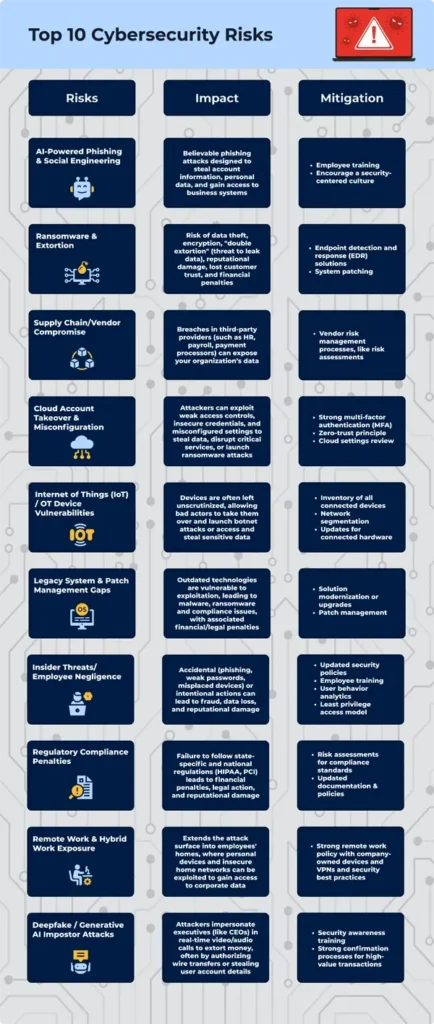
If you’re looking for help defending against these rising cybersecurity risks, reach out to book your free security consultation.
Why Tampa Businesses Are Particularly Exposed to Cybersecurity Risks in 2026
Because of its uniquely growing business ecosystem and range of industries, Tampa Bay businesses are particularly susceptible to cybersecurity risks.
Range of Industries
Tampa has a thriving concentration of industries, which is a major benefit for all Floridians. From banking and insurance to tourism and hospitality, many well-known businesses call Tampa home.
However, these industries often house sensitive information and user data, which are of particular interest to cybercriminals.
For instance, hospitals and healthcare organizations hold sensitive patient data (PHI), financial firms manage high-value assets, and tourism companies rely on extensive booking and customer data.
Cyberattacks in these industries are particularly damaging, thanks to the nature of the stored data and the business’ roles in the local community.
Take the 2023 Tampa General Hospital data breach, which affected over 1 million individuals. This cyberattack specifically targeted patient data because of its high value and confidentiality.
Another Tampa-local breach occurred when a bad actor gained access to an Oldsmar, Florida water treatment plant in 2021. In this case, the attacker attempted to tamper with chemicals in the water treatment system.
As these examples show, no organization is immune to cyberattacks.
High Number of SMBs
Tampa’s rapidly growing economy and increase in SMBs also makes it more vulnerable to cyberattacks than other cities.
A study by Coworking Cafe revealed that Tampa’s economy grew faster than other similar mid-sized cities from 2019-2023. New businesses are also increasing their footprints in the region, with business applications growing by 71% in the same time period.
With this incredible economic growth comes more cybersecurity risks. 2024 research by NinjaOne found that 94% of SMBs experienced at least one cyberattack.
Bad actors often recognize that SMBs don’t have enterprise-level security even if they house extremely sensitive data. Unfortunately, this trend makes SMBs primary targets for cyberattacks.
With Tampa’s business community growing at such a high rate, it’s absolutely critical for local businesses to prioritize strong cybersecurity risk management.
Local Threat Landscape
In addition to its range of industries and rapidly growing economy, Tampa is also at higher risk for cyberattacks than cities in other states.
Research shows that Florida had the fourth-highest amount of data breaches among US states, leaving Tampa businesses more vulnerable than other US cities.
In addition, Floridians also suffered greater financial losses than most other US states as a result of cyberattacks.
These threats mean that Tampa businesses, especially, need to take a proactive approach to their security and stay alert. Operating in such a high-risk environment necessitates proper cybersecurity risk management for all businesses.
How to Evaluate Your Cybersecurity Risk Posture
For Tampa businesses looking to improve their cybersecurity, it’s best to start by understanding current security controls and gaps.
Often, conducting a thorough cybersecurity risk assessment is the best place to start. Working with internal experts or an outside cybersecurity firm can ensure your assessment is in-depth and accurate.
Take the following steps so that no stone is left unturned.
Identify Critical Assets
Catalog all assets, including sensitive data, intellectual property (IP), operational systems, and IT assets. Make sure you understand the most valuable and critical assets, like confidential or classified information, as those might be of most interest to cybercriminals.
Understand Entry Points
Analyze potential paths that an attacker could take to access your system. These include internal networks, external-facing applications, third-party vendor or partner connections, phishing attempts, and misplaced work devices.
Assess Existing Security Controls & Gaps
Spend time reviewing your business’s current security controls, like firewalls, password policies, MFA, security awareness training programs, and other defenses.
Use risk matrices to calculate the probability and severity of risks so you can understand which gaps to resolve first.
Often, it’s best to partner with a professional cybersecurity organization who can uncover security weaknesses that you may not be aware of.
They can also conduct more in-depth testing with their team and implement security controls to guard against specific vulnerabilities.
Strengthen & Centralize Authentication
Moving to centralized login options like single sign-on is one step that can considerably reduce your organization’s attack surface.
Attack surface refers to the number of assets your organization maintains.
Each asset symbolizes an entry point for bad actors looking to access your accounts and networks.
The more assets they need to protect, the more entry points there are.
Single sign-on allows users to log in to each of your organization’s applications with one single account, like their email account.
Accessing each application is often as easy as a single click after initially signing in to a platform like Microsoft Office 365.
In addition to increasing security for your business, single sign-on also boosts efficiency for your employees by reducing the amount of time they spend logging in to different accounts throughout the day.
Continuous Cybersecurity Risk Monitoring & Incident Readiness
Security is not a “one and done” process; it requires ongoing analysis, prioritization, and vulnerability resolution. Make sure you have 24/7 monitoring and available teams in place to assist.
You’ll also want to develop a detailed incident response plan, as part of your cybersecurity risk management framework, that dictates recovery efforts and minimizes damages should a breach occur.
Over time, revisit your security controls and plans to ensure they still align with current recommendations.
How Miles IT Can Help Tampa Businesses Mitigate Cybersecurity Risks
As a Tampa managed IT services and cybersecurity company, Miles IT is perfectly positioned to help Tampa businesses navigate the unique cybersecurity risks of 2026.
How Miles IT Supports Tampa Businesses in Cybersecurity Risk Management
When it comes to cyber risk mitigation, we go beyond standard IT support; our team integrates security into every aspect of our clients’ operations.
Our solutions are designed to address the specific vulnerabilities faced by the Tampa Bay business community.
Beyond that, we have a deep understanding of industry-specific needs, from healthcare to finance to tourism, allowing our team to put the right protections in place for every business.
Our Cybersecurity Service Capabilities
Risk Assessment
We begin with a comprehensive cybersecurity risk assessment to clearly identify gaps and rank risk in terms of severity and likelihood.
Managed Security Services
As an MSSP, we have a 24/7 Security Operations Center (SOC) and offer ongoing monitoring, threat detection, and incident response planning and action.
Incident Response
Our team provides rapid response, analysis, and containment to remove threats and get your business operational again.
Compliance Support
We help to ensure your business meets Florida-specific and industry-necessary regulations by implementing the right security controls, assisting with documentation creation and cybersecurity risk management frameworks, and helping to prepare for audits.
Employee Education
We reduce the chances of insider threats by providing continuous security awareness training focused on social engineering and defending against AI cybersecurity risks.
Miles IT’s Local Advantage in Tampa
With a team of cybersecurity experts located in Tampa and the surrounding Florida region, we understand the unique challenges and risk profiles of the Tampa Bay area.
We work with a variety of Tampa businesses to provide personalized solutions that fit their organizational needs and budgetary requirements.
Schedule a complimentary cyber risk review with Miles IT today to gain a better understanding of cybersecurity risks affecting your business.
Final Thoughts
Tampa businesses face many cybersecurity risks due to the unique business landscape and Florida’s increasing susceptibility to cyber threats. And with the rise of cyberattacks thanks to AI-powered technologies, the risks are greater than ever.
If you need a trusted partner to provide support, expertise, and local insight to secure your organization, Miles IT is here to help. Don’t wait for an attack to happen.
Contact Miles IT and schedule a cybersecurity risk assessment today.
Frequently Asked Questions
How much can a cyber breach cost a Tampa business?
According to IBM’s Cost of a Data Breach 2025 report, the average cost of a data breach, based on worldwide data, is $4.4 million. Though this number has actually decreased by 9% in recent years, it’s still a reminder of the devastating impact of cyberattacks and the importance of strong proactive cybersecurity practices.
What regulations should Tampa-based businesses be aware of?
Tampa-based businesses should be aware of Florida-specific regulations as well as the necessary compliance standards for their organization. For instance, healthcare organizations must ensure compliance with HIPAA, while retail businesses and any business that handles credit card transactions must follow PCI guidelines.
Florida-specific laws include the Florida Cybersecurity Act, which governs security across state and local government agencies. However, these regulations also apply to other organizations, like public schools and universities. It’s critical to review the laws in reference to your specific business to determine whether these policies apply to you.
Other laws include the Florida Information Protection Act, which requires companies to protect users’ personal data and report any breaches to those users, and the Florida Computer Crimes Act, which penalizes individuals who access computers and personal data without authorization.
How often should we review our cyber risk posture?
Security is not a one and done checkbox item; it’s important to remember that completing a security posture assessment once does not exclude you from needing another at a future date. The threat landscape is constantly evolving, and businesses should treat security as an ongoing process.
Most compliance standards require annual cybersecurity risk assessments, and you should plan on updating and communicating your security policies annually as well. It all depends on your industry and nature of your business, though; in some cases, more frequent reviews may be necessary.
Can Miles IT help with compliance and incident response?
Absolutely! Miles IT offers governance, risk, and compliance advisory services in addition to incident response services. For businesses seeking regulatory compliance assistance, we provide documentation assistance, audit preparation and guidance, security posture assessments, penetration testing, network scanning, SIEM services, and more. Each of these service offerings are designed to help clients ensure that their systems and processes are compliant with the appropriate standards.
When it comes to incident response, we provide rapid response, analysis, containment, and recovery services to remove cyber threats and restore business operations. Our managed security services include ongoing monitoring and incident response planning.