



A Fractional CFO’s Guide to Choosing a Managed Security Service Provider
As cybersecurity teams and financial departments become increasingly intertwined, it’s more important than ever for fractional CFOs to lead the charge in advocating for strong security measures.
The stakes are high—the average cost of a data breach in 2025 was $4.4M, and fallout includes regulatory penalties, downtime, and reputational damage.
And with the average cost of downtime being $427/minute for small businesses and $9,000/minute for larger companies, the financial consequences are massive.
To properly manage these risks, many companies turn to a managed security services provider (MSSP) for help. Often, working with an external security partner like this is more cost-effective and secure in the long run.
As a trusted leader and consultant, you’ll want to help your clients through this process and ensure they select the best MSSP partners.
Having a strong understanding of different evaluation criteria and ROI calculations can streamline this process and boost your credibility.
Read on to gain a structured, actionable decision framework for helping your clients select and onboard an MSSP, as well as common mistakes to avoid throughout the process.
What You’ll Learn:
- The cost comparison of building an internal IT team vs. working with an MSSP
- Key criteria for evaluating MSSP partners
- The ideal decision framework for selecting and onboarding an MSSP
- Common mistakes to avoid when choosing an MSSP
Why Fractional CFOs Should Consider a Managed Security Service Provider (MSSP)
The decision to invest in a Managed Security Service Provider (MSSP) isn’t only an IT consideration; it’s a core element of any smart business and financial strategy.
Many businesses take advantage of external security services. According to a 2025 Barracuda survey, 61% of organizations with 50-100 employees use MSPs for security support.
When your clients work with an external security partner, they receive a range of comprehensive services from experts who work with many businesses similar to theirs.
From a financial perspective, partnering with top managed security service providers often strengthens cost predictability while mitigating risks and expensive emergencies.
Cost-Benefit Analysis: Internal Security vs. External MSSP
The cost of building and maintaining an in-house, 24/7 Security Operations Center (SOC) is typically huge.
According to Arctic Wolf, this cost could reach at least $1 million annually if your clients wanted an experienced, 24/7 SOC team.
Building an internal team involves high salaries, retention costs, ongoing training, and expensive security tools.
An MSSP converts these high, often unpredictable costs into simple, subscription-based costs.
Some IT companies offer monthly plans, giving your clients flexibility and peace of mind that they won’t be locked into long-term contracts.
Top security partners also provide access to the best talent and tools that most smaller organizations cannot afford to manage in-house.
Typically, MSSP teams have worked with other customers in your clients’ specific industries, giving them unparalleled insights into common threats and the state of the current landscape.
When comparing total costs, the benefits of managed security services are vast: they ensure comprehensive security protection at a budget-friendly price.
Fractional CFO Takeaway: Working with an MSSP turns unpredictable, reactive IT spend into predictable, fixed costs. This type of partnership also gives your clients access to superior tools, top talent, and consistent support at a fraction of the cost. Plus, it improves your clients’ risk profile by reducing the probability and likelihood of cyberattacks.
Risk Reduction: Lowering Probability of Incidents
Cybersecurity risks aren’t only IT risks; they also represent major financial risks.
A single data breach, regulatory penalty, or period of downtime can severely impact a business’s finances and damage long-term growth.
With an MSSP as a partner, your clients will gain around-the-clock security monitoring and rapid incident response, dramatically lowering both the probability of a successful attack and the resulting financial impacts.
Some actions, like procuring a cyber insurance policy, can reduce the financial fallout of a security incident.
However, taking preventative action and working with an MSSP can lower the chances of an incident occurring in the first place.
Financial Predictability: Reducing Emergency Costs
As a fractional CFO, you champion financial predictability for their clients.
Cyberattacks, security team retention costs, and technology upgrades are anything but predictable. They can upset your clients’ carefully planned budgets and disrupt future financial performance.
Research shows that emergency fixes are 2-5x more expensive than proactive maintenance, making these expenses not just stressful, but costly.
On the other hand, an MSSP contract provides a fixed, recurring cost with proactive maintenance that prevents costly, reactive repairs.
Plus, MSSP contracts ensure clearly defined agreements for detection, response, and resolution times.
This type of model shifts the reactive costs of emergency fixes into a stable, fixed operational cost, making financial forecasting more accurate and predictable.
Compliance Assistance
Businesses must align their processes and systems with the appropriate compliance standards for their industry and location in order to reduce the likelihood of financial penalties and reputational damage
These standards may include HIPAA, PCI, CMMC, and NIST 800-171, in addition to state-specific requirements.
MSSPs often have in-depth background knowledge regarding these compliance standards; they can help your clients establish the right procedures that align with regulatory requirements.
Top MSSPs can also assist with documentation and guidance throughout the audit process.
Whether your clients’ business falls within the purview of HIPAA, PCI, or another compliance standard, MSSPs can strengthen their security posture to help ensure regulatory alignment and reduce the risk of penalties.
Key Criteria for Evaluating an MSSP—What CFOs Should Check
When vetting managed security service providers, fractional CFOs must take a strategic approach to be confident they are recommending the best partners to their clients.
Recommending a partner who turns out to be unreliable or unprofessional can not only damage your clients, but also your reputation as a knowledgeable, helpful business consultant.
Evaluating a service provider means more than verifying technical features.
You should assess criteria that affect your clients’ overall risk profile, bottom line, and future growth to ensure the chosen MSSP is not just a third-party vendor, but a long-term partner.
Breadth of Service
The best MSSPs provide an all-encompassing defense strategy, not disconnected services.
This typically starts with a 24/7 Security Operations Center (SOC) to ensure consistent monitoring for your clients, regardless of time zone.
You’ll also want to assess the provider’s capability for rapid incident response. Often, containing and removing a threat more quickly can minimize downtime and associated costs.
Make sure the MSSP has expertise in regulatory standards relevant to your clients’ businesses, whether they be industry-specific regulations like HIPAA and PCI or state-specific requirements.
Finally, examine the MSSP’s ability to provide proactive support through vulnerability assessments and threat intelligence. Proactive services are essential to ensure proper system maintenance and to prevent major incidents.
In summary, MSSPs should have:
- 24/7/365 Security Operations Center (SOC)
- Guaranteed rapid incident response
- Proactive maintenance & support through vulnerability assessments and threat intelligence
- Expertise in relevant regulatory standards (HIPAA, PCI, state-specific requirements)
Transparency, Reporting, & Contracts/SLAs
Any MSSP partnership must have a strong foundation of mutually understood expectations to build accountability. Verify that all contracts/Service Level Agreements (SLAs) contain a guarantee for response time.
Your clients deserve high-quality service; a clear agreement ensures accountability for the IT provider, laying the groundwork for a trusted partnership.
For this same reason, you’ll want to be sure the MSSP provides regular reporting to help track performance over time.
Finally, find out if the MSSP offers audit prep, including documentation assistance, for clients in regulated industries. Working with an experienced provider can help smooth out the audit process for your clients.
Long-Term Stability & Scalability
The right MSSP should be a long-term partner, working with your clients to strengthen security systems and processes over time.
Confirm the MSSP is financially stable and ready to provide long-duration support.
Another crucial aspect of evaluating an MSSP is scalability. Will the provider be able to grow with your clients’ businesses, whether they enter new markets or expand their workforce?
The right MSSP should be able to continually support your clients and seamlessly contribute to their growth instead of impeding it.
Reputation, References, & Track Record
Evaluating a managed service provider’s history is one of the best predictors of future performance.
Carefully review their track record, including client testimonials and case studies that demonstrate their processes and knowledge in real situations.
You can also seek industry-specific success stories to gain an idea of their experience working in unique verticals. Talk to other fractional
CFOs and business leaders in your network to see if they have any recommendations.
A strong, proven reputation is essential when evaluating IT providers and MSSPs.
Full Understanding of Responsibilities
Before your clients enter an agreement, they’ll want to know which events are covered under the contract and understand the financial protection they will gain.
For instance, make sure they know exactly what the MSSP handles if a security incidente occurs.
What security events and assets are specifically covered under their services? What labor is covered by the MSSP (identification, remediation) and what is the timeline?
Some MSSPs only cover identification, providing remediation at an additional cost.
Contracts must explicitly lay out the MSSP’s responsibilities in the event of an incident to prevent surprise costs and ensure fast remediation.
A CFO’s Guide to MSSP Due Diligence & Onboarding Processes

Your role in the MSSP due diligence and onboarding process should focus on helping your clients reduce risk while ensuring long-term growth.
Read on to discover specific steps you can take to enable a successful partnership.
Step 1: Understand Primary Pain Points
As you help clients choose an MSSP partner, it’s essential to understand their current challenges and the hallmarks of a top IT provider.
For instance, is your client currently losing productivity due to slow, unreliable technology? Is their current provider responding fast enough? Do they have a future-proof IT strategy in place?
These issues can compound over time, reducing the value of a partnership and resulting in a greater cost to your clients.
Consider this example. If your client’s current provider isn’t responding quickly, that can lead to extra minutes (and hours) of downtime.
In the long run, this can lead to lost business and productivity.
Make sure you understand your clients’ current pain points and what they seek from a new partnership.
Are they looking for a provider that responds more quickly? Do they want more consultation and focus on overall IT strategy? Do they need a larger team to support their growing business?
Understanding these goals ahead of time can help inform the vendor selection process.
Step 2: Vendor Selection Based on Criteria
Leverage the key criteria listed earlier (breadth of service, transparency & reporting, long-term stability, and reputation) to create a vendor shortlist. Your clients should take an in-depth approach when meeting and vetting IT providers and MSSPs.
Start with the partner’s track record. Are they considered a top managed security service provider with specific expertise in your client’s industry? Do they have detailed case studies and glowing client references?
Gain a clear picture of what it’s like to work with the provider in terms of responsiveness, service guarantees, and professionalism.
Your clients will also want to make sure the vendors on the shortlist meet their expected needs. Do they have a 24/7 Security Operations
Center (SOC)? If your clients require an onsite presence, do these providers have a local team?
Spend time thinking carefully about each of these partners and if they would be a good fit instead of rushing into an agreement.
Step 3: Contract Agreement —SLAs, Responsibilities, Compliance Deliverables, Exit Strategy
As your clients move towards selecting a partner, make sure the following elements are present in their MSSP contract:
- Service Guarantees
Does the provider have reasonable response and resolution time promises? - Breach Responsibility
If a breach occurs, are responsibilities accurately and clearly defined? What labor is covered by the MSSP (identification, remediation) and what is the timeline? What is the possible remediation cost if a breach occurs? - Compliance Deliverables
Is it clear how the MSSP will provide documentation support for any compliance regulations? - Exit Strategy
Is there a clearly defined, reasonable exit policy in place? Will it be easy to switch providers if necessary?
Step 4: Transition Phase: Implementation, User Training, & Service Baseline
As your client onboards their new MSSP, there should be a structured plan to help the provider take the lead while minimizing downtime.
Implementation & User Training
The implementation process doesn’t only include technical setup; it also involves communication with your clients’ employees about changes.
Make sure their teams know how to report threats and vulnerabilities, both during regular hours and after hours.
This is also a valuable time to share any specific policy updates or information with them as the new partnership launches.
Service Baseline
The beginning of a partnership is an important time to create a baseline for support.
Take note of your client’s current risk profile and baseline costs. Then, pay attention to average response times and remediation efforts. Do they align with expectations?
These efforts can help you and your clients gain an accurate understanding of the ongoing value of the MSSP.
Step 5: Review Periods & KPIs—Ensure Service Delivery and Continuous Improvement
Cybersecurity is an ongoing investment, not a one-time project. Establish a structured, quarterly review setup for your clients and their
MSSP partners to discuss what is going well and potential areas of improvement.
You can also focus on value realization and continuous improvement as part of the assessment:
Key Performance Indicators (KPIs)
Review current metrics, like initial response times and resolution windows, against the original contract.
Are these times still what they were at the beginning? Does it match what your client expected?
Create Clear Roadmaps
Use these reviews as a jumping off point to align the MSSP’s evolving services with the changing risk landscape and your client’s projected growth.
Common Mistakes & What to Avoid When Choosing an MSSP
No business wants to enter a risky partnership, but as a fractional CFO, this creates an additional level of danger for your established reputation.
Your clients should be aware of these common missteps to protect their organizations from working with unreliable providers.
Paying for Overlapping/Redundant Services
Some organizations find that they’re paying for multiple services that, essentially, offer the same benefits.
For instance, your clients may be paying for a service that is already included in one of their subscriptions, like overlapping malware protection.
Build a transparent understanding of what is included in every service and subscription so you can be sure your clients aren’t paying for duplicate services.
Choosing the Lowest-Cost Provider Without Vetting Their Credentials or Security Posture
While minimizing costs is valuable to ensure profitability, choosing the lowest-cost IT provider may result in poor quality work and limited expertise.
A partner with inexpensive pricing may not be the best option; they might not invest in the best MSSP software tools, hire the best talent, or maintain 24/7 operations.
The minor cost savings your clients would get would quickly be eclipsed by the costs of an incident like a data breach if the MSSP isn’t fully equipped to handle it.
Always check that the MSSP has proper security certifications, and ask for audit reports detailing the MSSP’s security posture. Your clients should have a full picture of the organization so they can make the most informed decision.
Entering Long-Term Contracts
Beginning a long-term contract with a service provider can be risky for a number of reasons.
For instance, if your client is “locked in” to a service agreement but experiences issues with their IT provider, it’ll be difficult for them to exit the contract. Every minute of downtime due to slow response or inefficient technologies represents business loss and wasted productivity.
In addition, long-term contracts don’t provide flexibility as the economic landscape and business trajectories change. This rigidity makes it difficult to adapt to changes and build a future-proof IT strategy.
Working with providers that bill monthly can be a helpful solution. This model allows your client to exit unsatisfactory partnerships without penalty. It also allows for easy adaptations to changing market conditions.
Failing to Review Incident Response/Resolution Time
Shortlisted MSSPs may tell you one story about their response and resolution time, but the truth may be something else altogether.
Make sure you connect with references and other customers to gain a deeper understanding of the provider’s actual performance history.
Top managed security service providers should offer transparency around these guarantees and be able to confidently share references with your clients.
Failure to Align Service Offerings with Industry Regulations & Risk Profiles
Working with an MSSP shouldn’t be a cookie-cutter, one-size-fits-all partnership.
The right MSSP will take time to understand your client’s unique business and how they operate.
If your clients must follow regulatory standards like HIPAA or PCI, make sure the MSSP has current knowledge in these areas. Ideally, they should already work with businesses affected by these regulations.
Choosing a generalized provider for a highly regulated business can lead to financial penalties, legal action, and reputational damage.
How to Calculate ROI & Risk-Adjusted Cost for Security Investments
Exploring MSSP partnerships isn’t a simple security cost; instead, it’s a risk reduction expense.
Help your clients calculate ROI to demonstrate the benefits of managed security services.
Expected Loss Model: Probability x Impact
One effective financial model for explaining cybersecurity ROI is the Expected Loss formula. You can use it to compare the financial risk before partnering with an MSSP to the risk after partnering with an MSSP.
Expected Loss = Probability of Incident x Financial Impact
Probability: The likelihood of a successful security incident (data breach, ransomware attack) occurring
Impact: The total financial cost to the business if the security incident occurs (business interruption, recovery costs, regulatory fines)
You can determine the MSSP’s value by seeing how much they reduce the total expected loss.
For instance, an MSSP lowers the Probability of an incident occurring through 24/7 monitoring, proactive threat hunting, and vulnerability scanning.
An MSSP also reduces the Financial Impact through fast detection and incident repsonse, lowering downtime periods, data loss, and overall impact.
Example Scenario: The ROI of Cybersecurity Investments
To determine the ROI of cybersecurity investments, you’ll want to calculate the financial loss your clients can avoid. You can use industry baselines to help estimate associated costs.
ROI = Reduction in Expected Loss – Investment Cost
Cybersecurity ROI is calculated not by revenue generated, but by loss avoided.
Research from SolarWinds shows that downtime costs smaller businesses $25,620 per hour. Let’s say your clients’ business operations are impacted by a cyber incident and are down for 1 day.
With 8 hours in 1 workday, the business would face an average downtime cost of almost $205,000.
But, if they had a complete disaster recovery and backup system, they could return to normal operations much more quickly—eliminating that expensive downtime cost.
You could calculate the ROI by estimating the investment in a disaster recovery and backup system and subtracting that figure from $205,000.
Shifting from Variable Risk to Fixed Predictable Cost
One of the greatest benefits of managed security services is moving from unpredictable, reactive security costs to a stable, fixed operating expense.
Before partnering with an MSSP, security spending for your clients may be volatile. It might include unplanned expenses for emergency incident response, ad hoc costs for hiring security specialists, and sudden, unforeseen tech upgrade costs.
Some businesses may also have to pay financial penalties if they don’t follow regulatory requirements.
With reactive security spending, financial forecasting is incredibly difficult.
However, working with an MSSP enables predictable, fixed, recurring security spending. The MSSP absorbs costs of internal staffing, tool maintenance, and 24/7 coverage.
This way, businesses can budget for security as a predicted expense instead of a reactive emergency cost. As a result, working with a managed security service provider can dramatically improve the accuracy of financial forecasting.
Comparison Table: In-House Security vs. MSSP
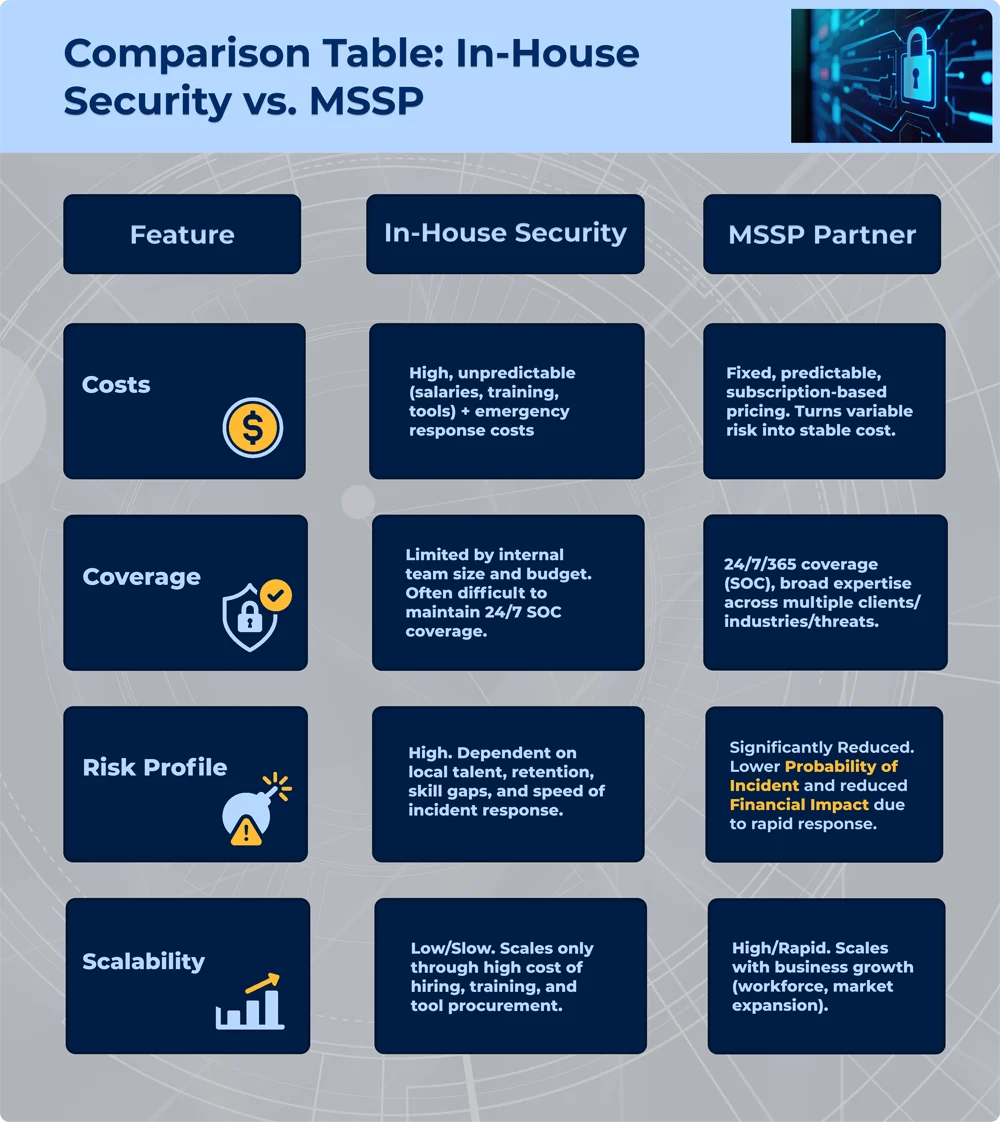
Based on the comparison table, an MSSP is often the best choice for many organizations, especially those seeking financial predictability and improved risk management.
The MSSP model allows businesses to convert reactive security spending into a predictable operating expense while providing access to superior, 24/7 expertise and the best MSSP software solutions that would be expensive to purchase in-house.
Final Thought
Selecting the best managed security service provider is a consequential financial decision that can significantly improve your clients’ financial outlooks and risk profiles.
As a key advisor to them during this process, you’ll want to provide the best guidance and help them avoid risky partnerships.
Make sure you take a thorough, in-depth approach to MSSP evaluation and selection, keeping transparency, service breadth, and reputation in mind.
If you’re ready to take action, a risk audit is often the best place to start.
Need help starting your audit and jumpstarting the process? Book a no-cost consultation with our security experts today.
Frequently Asked Questions
Why should fractional CFOs be directly involved in selecting an MSSP?
Strong cybersecurity is a crucial aspect of enterprise risk management. Seeing as fractional CFOs are already involved in other aspects of risk mitigation, it makes sense that they play a role in evaluating and selecting MSSP partners.
Left unchecked, cybersecurity represents a major threat to businesses.
Taking a strong security stance helps fractional CFOs protect their clients’ finances and ensure they make the smartest investments.
How can fractional CFOs evaluate the ROI of a managed security service provider?
Fractional CFOs can evaluate the ROI of an MSSP by viewing the partnership as an opportunity for risk reduction instead of only a security cost.
The Expected Loss Model can help calculate ROI. By reducing the probability and impact of a security incident, working with an MSSP can minimize extended downtime periods and other related costs.
Focusing on financial predictability is another way to evaluate the ROI of an MSSP. Working with a trusted security partner long term shifts security spending from a reactive expense to a fixed, predictable cost. This approach helps simplify budgeting and improve financial forecasting.
What core services should CFOs look for when selecting an MSSP?
The top MSSPs provide a comprehensive defense strategy designed to protect clients and provide consistent monitoring. Major services include a 24/7 Security Operations Center (SOC), which enables fast response and around-the-clock support.
MSSPs should also have expertise in compliance regulations and be able to help your client align their systems and practices with the appropriate standards.
Finally, the provider should offer proactive services to ensure ongoing system maintenance and prevent small issues from unfolding into large-scale incidents.
How can a fractional CFO ensure an MSSP will sustain long-term growth and align with their clients’ needs?
Choosing the right managed security service provider all comes down to taking the right steps in the evaluation process.
Make sure the vendor has a strong reputation and background knowledge to support your clients’ needs.
Spend time following up with any provided references, especially those in your clients’ industries. Are they happy with their current service plan? How fast are response times?
You’ll want to work with a partner who prioritizes transparency and accountability. All service agreements should be clear, with defined responsibilities and guaranteed response and resolution times.
By taking a structured, detailed approach to selecting a partner, you can better help your clients find the right MSSP for their needs.
How does working with an MSSP compare to building an internal security team, from a finance perspective?
It can be prohibitively costly to build a strong internal security team. You have to take a variety of factors into account, from ensuring 24/7 team availability to ongoing retention costs to the price of security tools.
Working with an MSSP can give you access to top security specialists and tools at a fraction of the cost of building a team yourself. These experts typically have worked with customers in your clients’ industries before, giving them greater knowledge of the current threat landscape and potential threats to your clients’ businesses.
The top managed security service providers will often invest in the best MSSP software solutions and tools, so your clients will enjoy peace of mind knowing that they’re protected by strong security systems.
Plus, working with an MSSP is often more scalable for businesses looking to grow. If the provider has the capacity to support your clients’ growth, it may only require a contract adjustment instead of hiring additional internal staff.